
How to Generate Five-Letter Words
Five-letter words are useful in far more situations than word puzzles. Writers can use them for constrained writing exercises, teachers can turn them into vocabulary activities, and word-game players can use them to build practice lists. Sometimes you simply need a large collection of words that meet a particular pattern, such as words beginning with a certain letter or containing a known group of letters.
The good news is that you do not need to rely on memory alone. There are several reliable ways to generate five-letter words, from simple brainstorming to filtered word lists and dedicated generators. The best method depends on whether you need completely random words, words matching specific letter constraints, or words selected for a particular purpose.
What Counts as a Five-Letter Word?
A five-letter word is a word whose standard spelling contains exactly five alphabetic characters. For example, apple, river, chair, plant, and stone each contain five letters.
When building a five-letter word list, it helps to decide what you mean by “word.” A broad list might include common nouns, verbs, adjectives, adverbs, and other parts of speech. A specialized list might include only everyday vocabulary or only words that are useful for a particular word game.
There can also be differences between a dictionary word list and a game-specific accepted-word list. Some dictionaries contain inflected forms, uncommon vocabulary, technical terms, archaic words, or regional spellings that may not be accepted by a particular game. If your goal is gameplay, check the rules or accepted vocabulary for that game rather than assuming every dictionary entry will qualify.
Method 1: Brainstorm Common Five-Letter Words
The simplest approach is to generate words from memory. Start with familiar categories and work systematically instead of trying to think of words at random.
For example, you might make groups such as:
- Objects: table, chair, plate, glass
- Nature: river, plant, grass, ocean
- Animals: horse, sheep, mouse, tiger
- Actions: climb, write, laugh, dance
- Descriptions: happy, quiet, large, sweet
- Places or settings: beach, house, hotel, field
This approach is particularly useful for classroom exercises because students can generate words while also practicing vocabulary and parts of speech.
A useful trick is to choose a theme first. If the theme is “things in a kitchen,” you can search your memory for five-letter objects. If the theme is “verbs,” focus only on actions. The category gives your brain a starting point and reduces the feeling of staring at an empty page.
Use Letter Patterns to Expand the List
Once you have a few examples, examine their first or last letters. If you need more words beginning with S, for example, try generating several familiar words starting with that letter and then discard anything that is not exactly five letters long.
You can also work backward from endings such as -ing, -ed, or -ly, while remembering that the resulting word must still contain exactly five letters. This is less useful for broad vocabulary generation but can be effective when a writing or puzzle exercise has a specific structure.
Method 2: Start With a Five-Letter Word List
If you need dozens or hundreds of possibilities, manually brainstorming is inefficient. A five-letter word list gives you a much larger starting pool that you can then filter.
A useful list can be organized alphabetically, by word frequency, by part of speech, or by letter pattern. For example, an alphabetical list makes it easy to find words beginning with a known letter, while a filtered list can help when you already know several positions in a word.
When using a word list, check whether it includes uncommon terms. A very large dictionary-derived list may contain words that are technically valid English but are not familiar to most readers. For general writing and classroom activities, a list of recognizable everyday vocabulary is often more useful than the largest possible list.
For quick generation, you can also use a five-letter word generator to produce words without manually searching through a long list.
Method 3: Generate Words From Letter Constraints
One of the most effective methods is to define the letters you know and then find words that satisfy those constraints.
Suppose you know that a five-letter word:
- starts with C;
- contains A somewhere in the word;
- ends with E;
- and cannot contain R.
Instead of searching your entire vocabulary, you can focus on patterns such as C___E and then test candidate words against the remaining conditions.
This method is especially useful for word-game practice. It turns a vague question—“What five-letter words could fit?”—into a sequence of smaller questions.
Separate Known and Unknown Positions
For a pattern such as:
C _ A _ Ethe first, third, and fifth positions are known. The second and fourth positions remain unknown. You can mentally test common combinations rather than considering every possible five-letter word.
Another useful pattern is:
_ R _ _ THere, you can focus on words with R in the second position and T at the end. This significantly reduces the search space.
Track Letters That Cannot Appear
Negative constraints can be just as important as positive ones. If your available information tells you that certain letters are absent, remove candidate words containing them.
For example, if the pattern is:
_ A _ _ Eand you know that S, T, and R are not allowed, immediately eliminate candidates containing those letters. This simple habit prevents you from repeatedly considering the same invalid words.
Method 4: Use Random Selection
Sometimes you do not need a carefully filtered word. You simply need a five-letter word selected from a suitable pool.
Random selection is useful for:
- writing prompts;
- vocabulary warm-ups;
- classroom games;
- creative constraints;
- brainstorming exercises;
- word-game practice;
- icebreakers and group activities.
For example, a writing teacher might ask students to generate three random five-letter words and write a short paragraph that includes all three. The words do not have to be related; the challenge comes from finding a natural way to connect them.
A random word tool can also make repeated activities faster. If you need a different prompt each day, you can generate a fresh selection rather than maintaining a large manual list.
If you need broader vocabulary rather than exactly five-letter words, the random word generator can provide a more flexible starting point. For a more specific result, the random noun generator or random verb generator can help constrain the type of word you receive.
Method 5: Generate Five-Letter Words for Wordle-Style Practice
Five-letter words are closely associated with Wordle-style puzzles, where players use repeated guesses to identify a hidden word. If you are practicing, generating random five-letter candidates can help you become more comfortable with common spelling patterns.
The goal of practice should not be memorizing an enormous list. It is more useful to notice recurring structures and letter combinations.
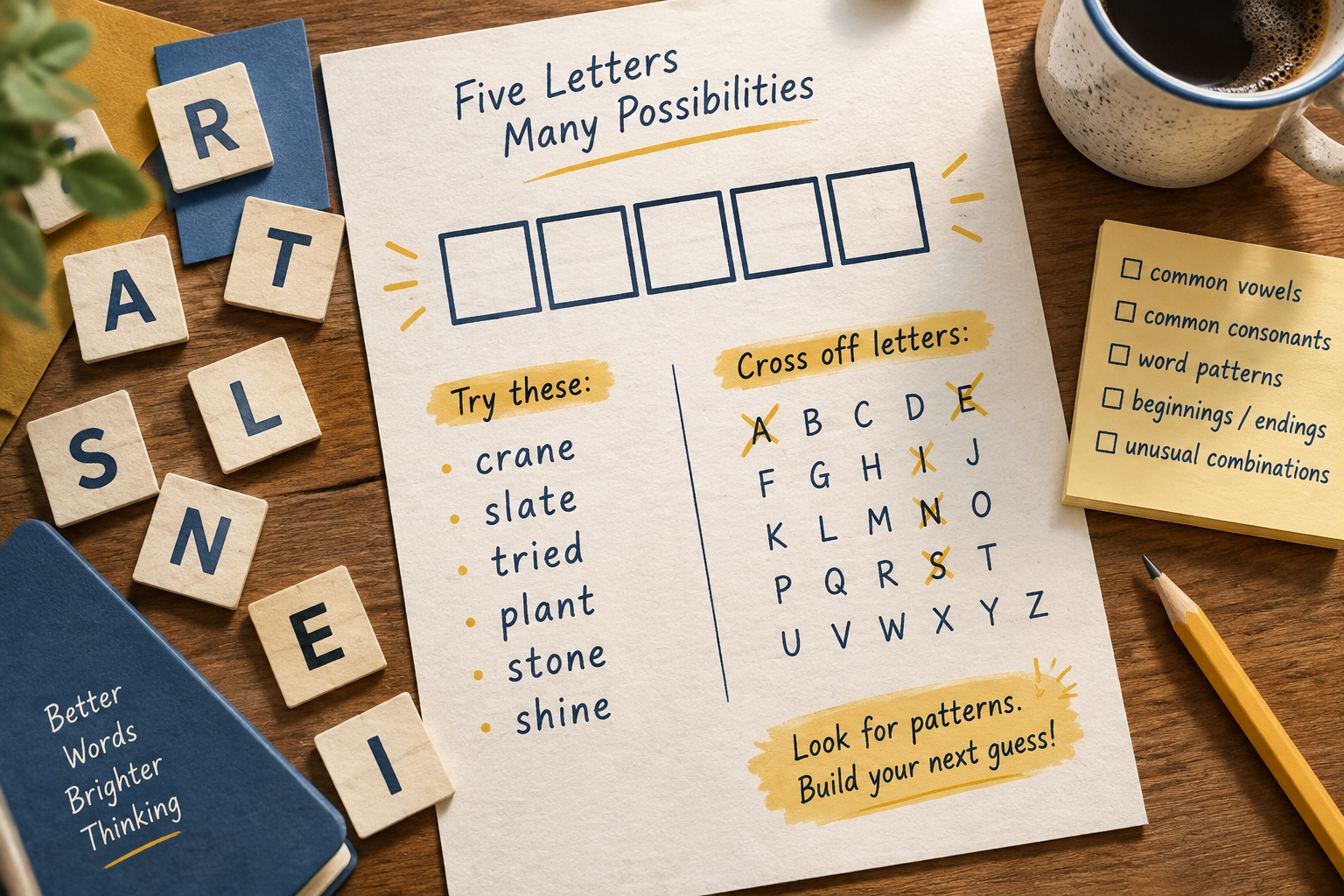
For example, pay attention to:
- common vowels such as A, E, and I;
- common consonants such as R, S, T, N, and L;
- repeated-letter patterns;
- common beginnings and endings;
- unusual but legitimate letter combinations.
A practical exercise is to generate a small batch of five-letter words and sort them by a feature. You could group them by their starting letter, number of vowels, repeated letters, or ending pattern. This turns passive list reading into active pattern recognition.
For more focused practice, use the five-letter word generator, then challenge yourself to identify possible patterns before checking a dictionary.
How to Generate Better Five-Letter Word Lists
Not every list is equally useful. If you are creating a list for another person, think about its intended purpose before generating it.
For Writers
Writers often benefit from words that are concrete, recognizable, and easy to combine. A list containing objects, sensory terms, actions, and descriptive vocabulary can produce more interesting prompts than a list made entirely of obscure dictionary entries.
Try combining categories. For example, generate one five-letter noun, one five-letter verb, and one five-letter adjective. Then use all three in a sentence or short scene.
For Teachers
Classroom lists should generally match the students' vocabulary level. Younger learners may benefit from familiar concrete nouns such as apple, house, or plant, while older students can work with more challenging vocabulary.
You can also turn a list into a sorting activity. Ask students to classify the words as nouns, verbs, adjectives, or another relevant category. Another option is to have students identify vowels, syllables, prefixes, suffixes, or spelling patterns.
For sentence-building activities, pair five-letter words with a random sentence generator to create additional prompts and constraints.
For Word Games
For games, the accepted vocabulary matters more than the size of the list. A giant dictionary can be counterproductive if many of its entries are not accepted by the game you are playing.
It is also useful to distinguish between words that are good guesses and words that are merely valid candidates. A strong practice list can emphasize familiar words and varied letter combinations rather than obscure entries.
A Practical Five-Letter Word Generation Workflow
If you need a repeatable process, use these steps:
Step 1: Define the purpose
Decide whether you need words for writing, teaching, brainstorming, or a word game. This determines how broad or specialized your list should be.
Step 2: Choose the source
For a small list, brainstorm from memory. For a larger list, start with a dictionary-based collection or use a dedicated generator such as the five-letter word generator.
Step 3: Apply the length rule
Check that every candidate contains exactly five letters. Remove spaces, punctuation, abbreviations, and longer or shorter forms unless your activity specifically allows them.
Step 4: Apply additional constraints
Filter by starting letter, ending letter, known positions, required letters, forbidden letters, part of speech, or topic.
Step 5: Remove unsuitable entries
Depending on your purpose, eliminate words that are obscure, offensive, highly specialized, archaic, or otherwise inappropriate for the audience.
Step 6: Organize the final list
Alphabetical order works well for reference. Random order works well for games and writing prompts. Grouping by category works well for classroom activities.
Practical Examples
Example: Generate Words Beginning With a Specific Letter
Suppose a student needs five-letter words beginning with B. Start by collecting candidates from memory, then verify their length:
beach
berry
black
blend
block
brain
bread
brick
brush
build
The exact final list can be expanded using a word list or generator. The important principle is to filter every candidate against the same rule.
Example: Create a Writing Exercise
Generate three unrelated five-letter words, such as a noun, verb, and adjective. The writer then has five minutes to create a paragraph containing all three.
For a harder version, add constraints such as “use the noun as the first word” or “write the paragraph without using the letter E.”
Example: Create a Classroom Challenge
Give students ten five-letter words and ask them to sort them according to a chosen property. They might separate words with repeated letters from words with five unique letters, or group words by their first letter.
This makes a simple word list more interactive and gives students a reason to inspect spelling rather than merely copying vocabulary.
Common Mistakes When Generating Five-Letter Words
Counting characters incorrectly
Words can look short while containing more than five letters. Always count the actual spelling rather than estimating visually.
Assuming every dictionary word is game-valid
A dictionary and a particular word game can have different definitions of an acceptable word. If the list is intended for gameplay, use the relevant game's rules as the final authority.
Overusing obscure vocabulary
Large lists can include unusual words that are technically valid but not useful for ordinary writing or classroom work. Consider your audience and purpose before treating every generated result as equally valuable.
Ignoring repeated letters
Repeated letters are an important part of five-letter word structure. If you are preparing for a word game, include examples with repeated letters rather than practicing only words with five unique characters.
Generating without a purpose
A random list is easy to produce, but a targeted list is usually more useful. Even one constraint—such as a starting letter, topic, or part of speech—can make a generated list much easier to use.
Frequently Asked Questions
How can I generate five-letter words quickly?
The fastest approach is to use a dedicated five-letter word generator. For a small number of words, brainstorming is also effective. If you need words matching known letters, use a filtered list or search by pattern rather than generating completely random words.
Where can I find five-letter word lists?
You can build a list from a reputable dictionary or vocabulary resource, or generate one with a dedicated word tool. For word games, make sure the list matches the game's accepted vocabulary rather than assuming every dictionary entry will work.
How do I generate five-letter words for Wordle practice?
Start with a five-letter word generator and create manageable batches of candidates. Study common letter patterns, vowels, consonants, repeated letters, and word endings. If you are solving an actual puzzle, apply the known and excluded letters to narrow the candidates instead of treating the entire list as equally likely.
Can I generate five-letter words for classroom activities?
Yes. Five-letter words work well for vocabulary sorting, spelling practice, sentence writing, timed brainstorming, and category games. Adjust the vocabulary difficulty to the learners and remove words that are inappropriate or unnecessarily obscure.
Can a five-letter word contain a repeated letter?
Yes. A five-letter word can contain repeated letters. Examples include words where the same consonant or vowel appears more than once. Repeated-letter words are useful to include when practicing word-game strategies because they create different possibilities from words containing five unique letters.
Should I use random words or selected words for writing prompts?
Both can work. Random words encourage unexpected connections and can be useful for creative exercises. Selected words are better when you want the activity to reinforce a particular theme, vocabulary level, or writing skill.
Final Tips for Generating Five-Letter Words
Generating five-letter words becomes much easier when you treat it as a filtering problem rather than a memory test. Begin with a suitable word pool, decide what qualifies, and then narrow the results according to your purpose.
For simple brainstorming, start with familiar categories and common letter patterns. For large lists, use a dedicated generator. For word-game practice, focus on constraints, repeated letters, and useful spelling patterns. For classrooms and writing exercises, prioritize words that create meaningful opportunities for students and writers to think, sort, combine, and experiment.
When you want a quick starting point, try the five-letter word generator. If your activity needs a different type of vocabulary, explore the random word generator, random noun generator, or random adjective generator and build your own five-letter word challenges from there.
The best word list is not necessarily the biggest one. It is the one that fits the task, audience, and rules you are working with.
FAQ
Does the tool know the daily answer?
No. It is a general five-letter word filter — it narrows the dictionary to your constraints rather than guessing a specific puzzle.
Can I rule out gray letters?
Yes. Add gray letters to the exclude box and yellow letters to contains.
How do I use the pattern box?
Type known letters in their positions and dots for blanks — c..ar matches chair, clear-style shapes exactly at those positions.