
Warm up before you play
Generate a batch of twelve five-letter words and read them aloud. It primes the exact letter-pattern recognition the daily puzzle rewards.
No account required. Results are generated in your browser.
Adjust the filters and generate a fresh list.
Random Word Kit · free tool
Free Wordle word generator: produce five-letter words or solve today's board with pattern, contains, and exclude letter filters.
Generate a batch of twelve five-letter words and read them aloud. It primes the exact letter-pattern recognition the daily puzzle rewards.
Enter your green letters in the pattern box (dots for unknowns), move yellow letters into contains, and put gray letters into exclude. The list shows every word that still fits.
Skim generated lists for uncommon words — the kind that turn three-gray opening guesses into lucky second-row solves.
Generate one list per day, pick a mystery word, and let a friend guess it against you for extra reps between official puzzles.
Type what you know using dots for unknown letters, like "c..ar" — the list narrows to matching five-letter words.
Yes. Add gray letters to the exclude box and add yellow letters to contains.
Yes. Copy your green letters into the pattern box, add the yellow letters under contains, and enter every gray letter in exclude. The generator returns only the five-letter words that still fit the board.
Starters rich in common vowels and consonants give the most information — words like audio, slate, or crane. Generate a few lists and note which openers you like best.
A wordle word generator is a simple but powerful helper for word-game players, writers, and teachers who need five-letter words on demand. Instead of staring at a blank grid, you can generate candidate words, filter them by pattern, and practice the same constraint-based thinking that makes Wordle satisfying. This guide explains how a five letter word generator fits into a repeatable Wordle solver workflow, with practical examples, classroom ideas, and answers to common questions. It focuses on clear steps, real constraints, and ways to improve your guesses without turning the game into random guessing.
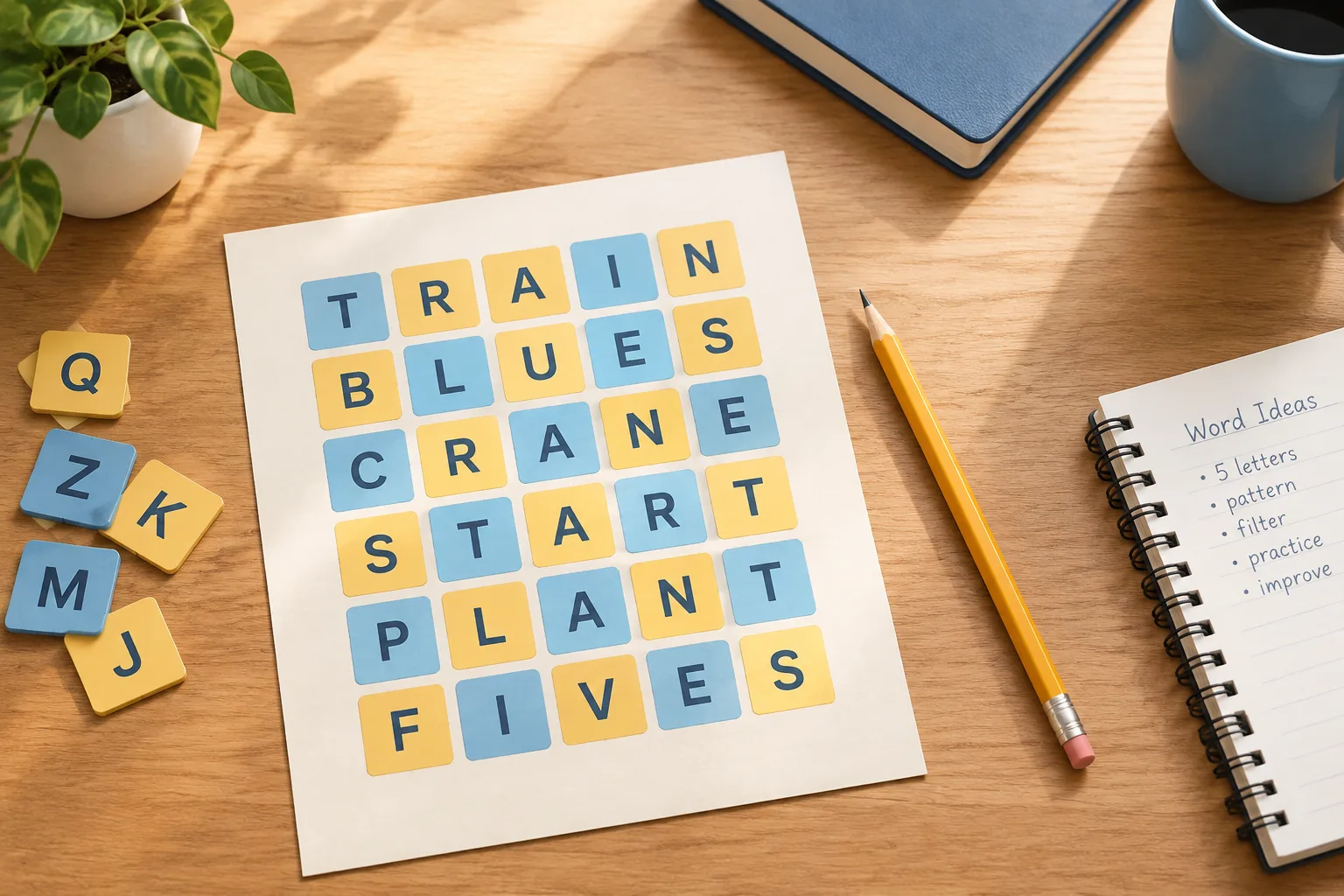
A Wordle word generator produces lists of five-letter words. Depending on the tool, you can often filter by length, starting letter, ending letter, included letters, excluded letters, and position. That matters because Wordle is not a vocabulary test alone; it is a logic puzzle built on letter constraints.
A good generator is useful in three moments:
Random Word Kit offers a random word generator and word tools that can support this kind of practice. The goal is not to skip thinking. The goal is to make your thinking more organized.
These three tools overlap, but they are not the same.
| Tool | Main job | Best used for |
|---|---|---|
| Word generator | Produces five-letter words or filtered lists | Practice, brainstorming, building candidate pools |
| Wordle solver | Applies game feedback to narrow possible answers | Checking a stuck puzzle or reviewing a game |
| Dictionary | Confirms meaning, spelling, and usage | Learning a word before you rely on it |
A generator gives you raw material. A solver applies constraints. A dictionary gives you confidence that a word is real and usable. The strongest workflow uses all three carefully.
Five-letter words sit in a sweet spot for word games. They are long enough to create interesting patterns but short enough that a player can hold several candidates in mind. That is why Wordle and many similar puzzles use five-letter targets.
A standard Wordle game gives you six guesses for a five-letter word. That means every guess should do work. If you waste a guess on a word that repeats gray letters or ignores known positions, you reduce your chances. A generator helps you avoid that waste by producing candidates that respect your current constraints.
Some letters appear more often in common five-letter words than others. Vowels are usually high-value early, but position matters too. An E at the end behaves differently from an E in the second position. A good Wordle solver workflow tracks both the letter and where it can legally go.
In Wordle hard mode, any revealed hint must be used in later guesses. If you find a green letter, you must keep it in that position. If you find a yellow letter, you must include it again. This makes filtering even more important. A generator that lets you lock positions and require letters is more useful for hard mode practice than a plain random list.
The best way to learn is to treat each puzzle as a small experiment. Use the generator to create options, then let the game feedback eliminate them.
A starter word should cover common letters without repeating them. Many players like words such as CRANE, SLATE, AUDIO, or RAISE. There is no single perfect starter for every puzzle, but a balanced word gives you useful information quickly.
If you are practicing, keep a short list of starter words and rotate them. This helps you learn how different letter sets behave.
After your first guess, write down what you know.
Then use a five letter word generator to list words that fit. For example, if you know the pattern is _ _ A _ _ and you must include R and E, you can filter out words with A in the wrong place or without the required letters.
A simple notebook page or spreadsheet works well. Make columns for guess number, word, and feedback. This turns a casual game into a repeatable Wordle solver workflow.
Do not trust memory alone. It is easy to forget that a letter was already gray. A written or typed record keeps you honest.
Try practice rounds where you allow yourself only generated candidates. Then try a round where you generate candidates but must explain why each one fits. The second version is slower, but it builds much stronger pattern recognition.
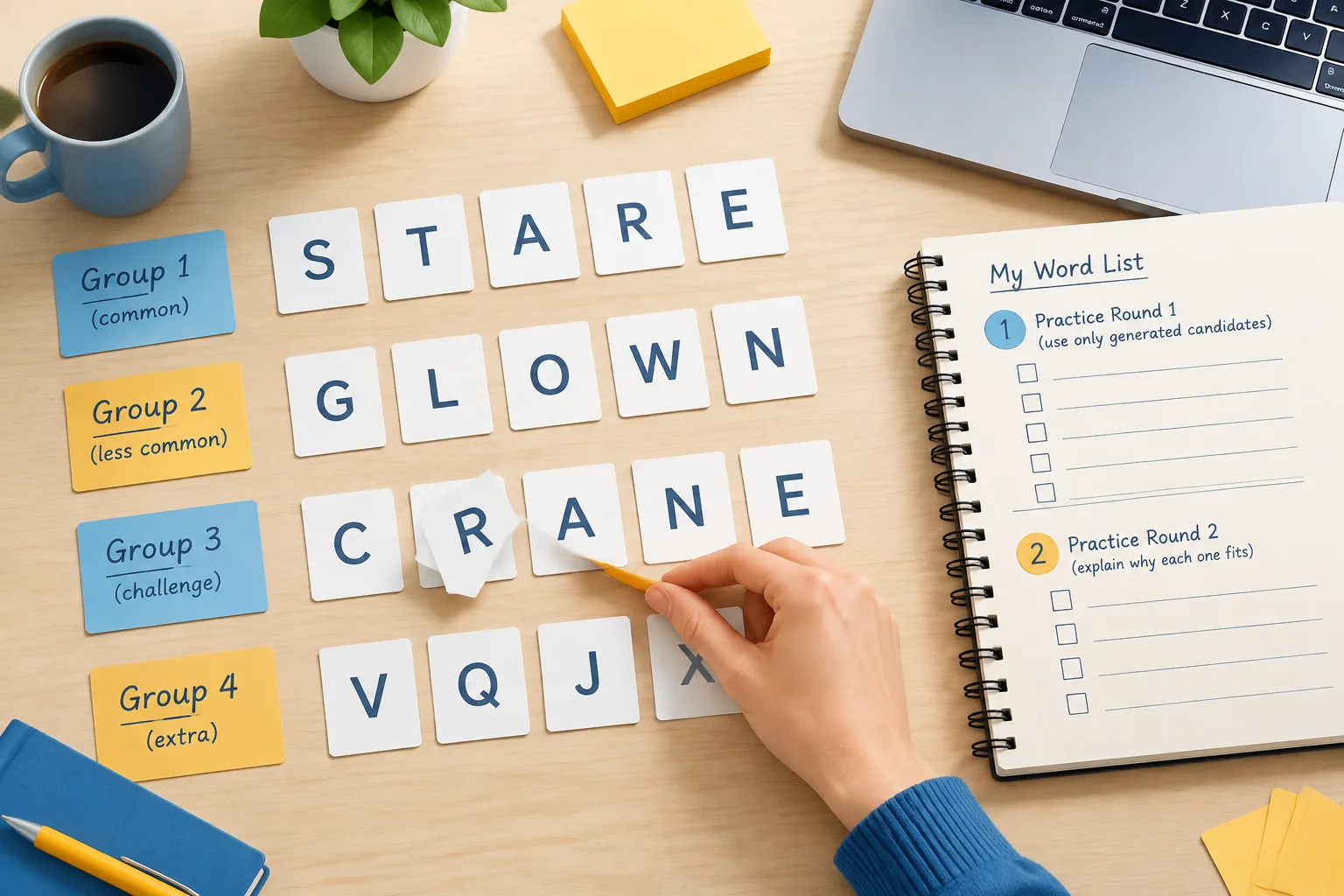
A Wordle solver workflow is a sequence you follow every time. It does not need to be complicated.
The important part is step 5. When several words fit, prefer the one that can eliminate more possibilities. If you already know the answer ends in E and contains R, a word that also tests T, L, and S may be better than a word that only rearranges known letters.
Suppose you start with CRANE.
Feedback:
Constraints:
Now generate candidates. Possible words include PEARL, HEARD, BEARD, and TEARY. Each one has A in position 3, includes R, includes E, and avoids C and N. They are not all equally strong. HEARD tests H and D. PEARL tests P and L. BEARD tests B and D. TEARY tests T and Y.
If you guess HEARD and receive feedback that H is gray, E is yellow, A is green, R is yellow, and D is gray, you have narrowed the field again. You now know H and D are out, E is not in position 2, and R is not in position 4. Continue generating and filtering until only a few candidates remain.
This is the core of Wordle solver thinking: feedback becomes constraints, and constraints become better guesses.
A five letter word generator is not only for games. Teachers, tutors, and writers can use it to create quick activities.
Give students a set of generated five-letter words and ask them to sort the words by meaning, difficulty, or part of speech. This works well as a five-minute warm-up.
Ask learners to find words with a specific vowel pattern, such as _ E _ _ _ or _ _ I _ E. Then have them read the words aloud and mark the vowels. The generator provides a fresh list without the teacher spending time brainstorming.
Generate five random five-letter words and challenge writers to use all five in a short scene. The constraint often produces surprising ideas. For classrooms, keep the words age-appropriate and be ready to swap out anything unsuitable.
Even with a good generator, some habits slow you down.
A generator produces candidates, not answers. It cannot know the daily Wordle target unless it is connected to a solver that uses live feedback. Treat generated words as possibilities to test.
A yellow square means the letter is in the word but not in that spot. Many players remember the letter and forget the position. That mistake leads to repeated guesses with the same wrong placement.
If a letter is gray and does not appear with another color elsewhere, it is out. Do not put it back into later guesses. This is one of the fastest ways to waste a turn.
Hard mode requires you to reuse revealed hints. If you ignore that rule while practicing, your normal-mode habits may fail when you switch. Use a generator that can lock green positions and require yellow letters.
Different word lists have different coverage. A word that appears in one generator may not be accepted by a particular game or puzzle. When a word matters, check it in a dictionary or a known word-game list before relying on it.
When you choose a tool, look for these features:
The five-letter word generator on Random Word Kit is designed for this kind of practice. Use it to build candidate lists, then apply your own feedback and reasoning.
A wordle word generator is a tool that creates five-letter words for Wordle practice, brainstorming, or solver workflows. It may also filter words by pattern, included letters, and excluded letters. It does not automatically know the answer unless it is paired with live game feedback.
Start with a balanced starter word and record the feedback. Convert green, yellow, and gray squares into constraints. Then generate a list of five-letter words that match those constraints. Choose the candidate that tests the most unknown letters, and repeat after each guess.
That depends on how you use it. If you use a solver to enjoy the puzzle or learn patterns, it is a practice aid. If you submit a solved answer without playing, you are skipping the game. Many players use solvers only after they are stuck or after the game ends to review what they missed.
Yes, if the generator supports filters. Hard mode requires you to reuse revealed hints, so you need words that keep green letters in place and include yellow letters. A simple random list is less helpful. A filtered list of candidates is much more useful.
Stop guessing randomly. List what you know: confirmed positions, letters that must appear, and letters that are out. Generate candidates that fit every constraint. If no word fits, recheck your feedback for a missed yellow or gray letter. Sometimes the error is in the notes, not the vocabulary.
A Wordle word generator works best when you combine it with a clear process. Pick a starter word, record feedback carefully, filter candidates, and choose guesses that eliminate possibilities. Over time, you will need the generator less because your pattern recognition improves.
Ready to practice? Try the five-letter word generator and build your next candidate list. For more word practice, explore Random Word Kit and its word tools for writing, classrooms, and word games.