
How to Play Pictionary: Complete Rules, Team Setup and House Variations
Pictionary is a drawing-and-guessing game where one player sketches a secret word while teammates race a timer to guess it. If you want to know how to play Pictionary at a game night, in a classroom, or with only two people, the core loop is simple: draw, guess, score, rotate. The details, such as what counts as a legal drawing, how teams rotate, and how to settle a disputed clue, are where most groups either have a smooth game or spend the evening arguing. This guide covers standard Pictionary rules, practical team setup, two-player variations, and house rules you can adapt for your group.
What Is Pictionary and Why It Works
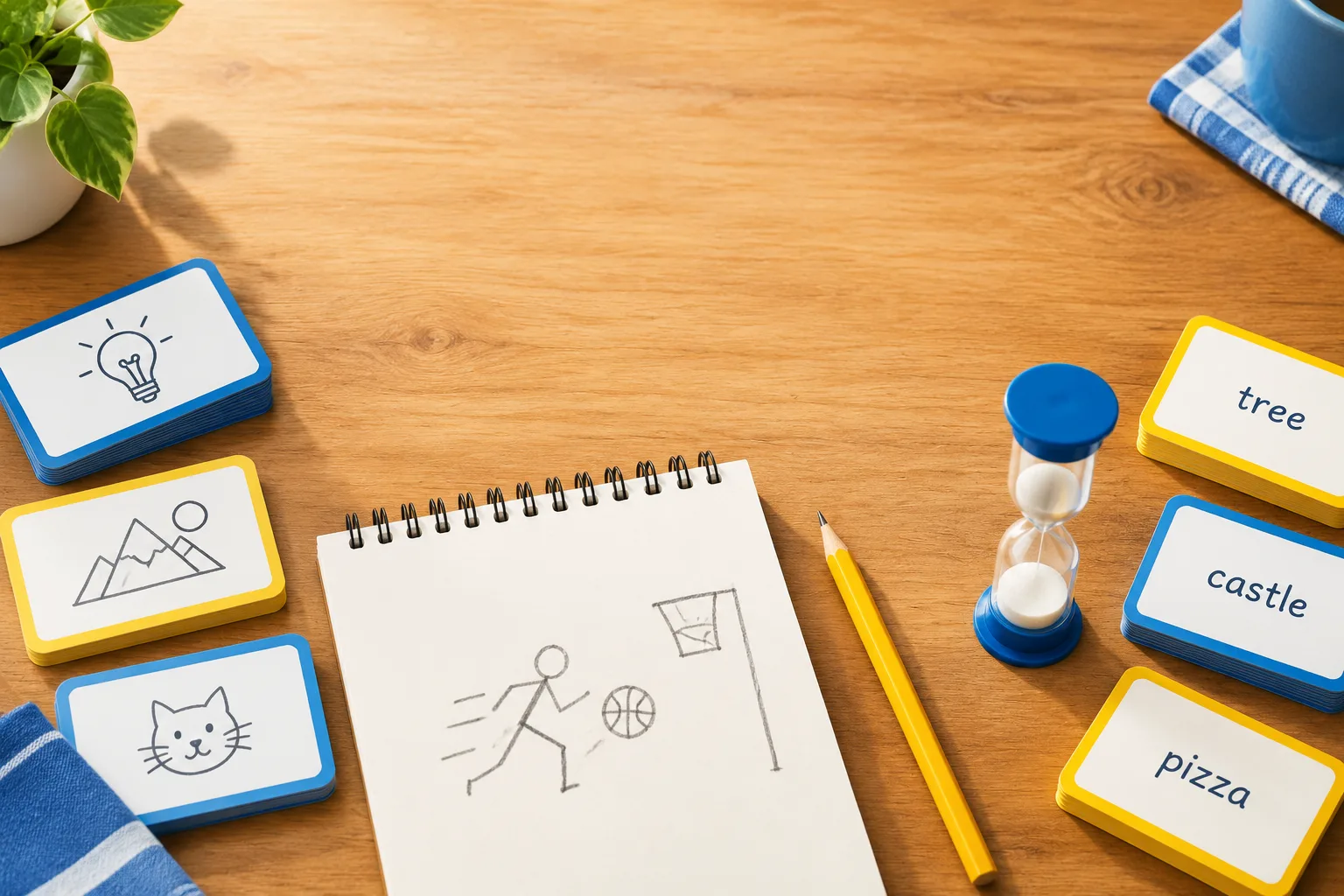
Pictionary is a party game built on quick visual communication. One person sees a word, then has to translate it into lines, shapes, and symbols fast enough for their team to guess. It works because it rewards clear thinking more than art skill. A stick figure can beat a beautifully shaded drawing if the stick figure communicates the right idea sooner.
The game has been published in many editions and spin-offs, so exact components vary. Some versions use a board, a die, and category cards. Others are sold as card decks or played with plain paper. The heart of the game stays the same: a drawer, a word, a timer, and a guessing team.
What You Need Before You Start
You can play Pictionary with an official box or with household supplies. Before the first turn, gather:
- A word source: official Pictionary cards, a printed word list, or a random word generator.
- A timer: a phone timer, sand timer, or kitchen timer set to 60 seconds for standard play.
- Drawing surfaces: a whiteboard, large notepad, or sheets of paper.
- Markers or pencils: dark colors are easier to see across a table.
- A score sheet: paper, a notes app, or the board from a boxed edition.
- Optional board and die: use them if your edition includes them and your group wants a longer path to the finish.
If you are building your own word list, start with concrete nouns and familiar actions. Abstract words are harder and often create more frustration than fun. For themed rounds, use a Pictionary word generator guide to create categories such as animals, movies, classroom vocabulary, or inside jokes. You can also browse ready-made Pictionary word lists if you want to skip setup.
Core Pictionary Rules: Turn by Turn
The standard turn structure is easy to teach. Adjust the winning score or timer to fit your group.
- Split players into two or more teams. Two teams is standard.
- Choose the first drawer for each team. Only the drawer sees the word.
- Give the drawer a word card or word from your list. In board editions, the word category may be set by the space the team occupies.
- Start the timer. Sixty seconds is the common default, but 45 seconds is a good speed option.
- The drawer sketches the word without speaking or writing letters.
- Teammates call out guesses. The drawer can nod or shake their head only if your house rules allow it. Standard rules usually do not allow any communication beyond drawing.
- If a teammate guesses correctly before time runs out, the team scores or advances.
- If time runs out, the turn ends with no score unless you are using a steal rule.
- Rotate the drawer and pass the word source to the next team.
For a paper-and-pencil game, keep a simple score tally. For a board game, follow the movement and category instructions printed in your edition. If the rulebook conflicts with what your group remembers, the rulebook wins for that session.
Pictionary Drawing Rules: What You Can and Cannot Do
The Pictionary drawing rules are the most common source of arguments. Agree on these limits before the first turn.
Standard restrictions:
- No writing letters, numbers, or full words.
- No drawing dashes or blanks that spell out the word.
- No speaking, whispering, mouthing, or making sound effects.
- No hand gestures, pointing at objects in the room, or acting out the word.
- No using a teammate's name as a clue.
- No erasing a large part of the drawing to start over if your group wants a strict pace. Many casual groups allow one quick correction.
Usually allowed:
- Stick figures, shapes, arrows, and action lines.
- Symbols such as a heart, star, plus sign, or clock face.
- Drawing a scene that suggests the word, such as a beach for island.
- Using color if markers are available, though color should not be required.
- Drawing a similar-sounding object if your house rules allow soundalikes. Standard rules often do not.
A practical test: if the clue only works because it contains letters, it is probably illegal. If it works because it shows an idea, it is usually legal.
Team Setup and Rotation
Pictionary team rules matter more than most players expect. Balanced teams create closer games and fewer complaints.
- Aim for two to five players per team. With two teams of two, every guess matters. With teams of five or more, consider splitting into three teams so everyone gets more drawing turns.
- Balance drawing comfort and guessing speed. Do not put every confident artist on one team.
- Rotate the drawer every turn. If a team has four players, each person draws once before the first drawer repeats.
- For odd numbers, one team can have an extra player, or one person can act as a rotating substitute. A neutral scorekeeper can also play as a substitute if needed.
- For large groups, run a bracket. Each round is one word per team, and the higher score advances. This keeps waiting time short.
- Keep the word source hidden from guessers. If the drawer picks from a visible list, other teams may see the next word.
If you have a mix of ages, create a simple difficulty system. Easy words are worth one point, medium words two, and hard words three. This lets younger players contribute without forcing them into impossible rounds.
Scoring, Penalties, and Winning
There is no single universal score target, so choose one before play. Common options include first to five correct guesses, first to ten points, or a timed game with the highest score after 20 minutes.
Paper scoring:
- One point for each correct guess.
- Bonus point for a hard word if you use difficulty tiers.
- No point for a skipped word.
- Optional steal: if a team fails, the other team gets 15 seconds to guess the same word for one bonus point.
Board scoring:
- Move the team token according to the die or the rules in your edition.
- Land on a category space, then draw from that category on your next turn.
- Some spaces may trigger all-play rounds or bonus moves. Follow the printed board text.
Penalties:
- If the drawer speaks, writes letters, or uses prohibited gestures, the turn ends immediately.
- If a guesser from the other team shouts an answer out of turn, give the drawing team five extra seconds or ignore the shout. Decide before the game.
- If the drawer cannot read or understand a word, allow one skip per team per game. Repeated skips slow the game and frustrate everyone.
How to Play Pictionary With 2 Players
How to play Pictionary with 2 players depends on whether you want competition or cooperation. The standard team game assumes at least four players, but two-player Pictionary works well with these adjustments.
Head-to-head duel:
- Player A draws, Player B guesses.
- Set a 60-second timer.
- If Player B guesses correctly, Player B scores one point.
- Swap roles. Player B draws, Player A guesses.
- First to seven points wins. For a shorter game, play to five.
Co-op challenge:
- Both players are on the same team.
- One player draws and the other guesses.
- Score one point for every correct guess within 60 seconds.
- Try to beat your previous score or clear a target of ten points in ten rounds.
- Swap drawer each round.
Solo practice:
- Draw a word for a set time without speaking.
- After the timer, reveal the word and note whether your drawing would have been guessable.
- Repeat with a themed list. This is useful for teachers testing word difficulty before class.
For two players, keep the timer visible and agree that the guesser can ask only for a repeat of the category, not for extra hints. If you want more variety, use a random word generator guide to build quick lists that do not repeat.
House Variations for Different Groups
House rules keep Pictionary fresh after the standard rules become predictable. Pick one or two, not five, so the game still feels like Pictionary.
- Speed Pictionary: 30 seconds per turn and no skips.
- Theme night: all words come from movies, music, food, or a holiday.
- Difficulty draft: before the game, each team chooses three easy, three medium, and three hard words.
- Steal round: if the drawing team fails, the other team gets 15 seconds to guess for a bonus point.
- One-word clue: after 30 seconds, the drawer may say one word. This is a house rule, not standard.
- Continuous line: the drawer cannot lift the pen from the paper. This raises difficulty and laughter.
- No erasing: every line stays. This rewards planning and punishes panic.
- Blind category: the guessers know only whether the word is a person, place, thing, or action.
- Team relay: each teammate adds one line, then passes the marker. The last person guesses.
For family game night, avoid words with adult themes and keep the timer generous. For competitive groups, use the steal rule and a strict no-talking policy.
Classroom and ESL Adaptations
Pictionary is a strong classroom game because it turns vocabulary into a visual challenge. It works for spelling words, science terms, historical figures, and ESL vocabulary.
Classroom setup:
- Divide the class into small teams of three or four.
- Give each team a whiteboard or a stack of paper.
- Use a 45-second timer to keep rounds moving.
- Project or hand out the word only to the drawer.
- Require silence from guessers except for the guess itself.
- Award one point for a correct guess and one bonus point for using the word in a sentence after the round.
ESL adaptations:
- Start with concrete nouns and everyday actions.
- Allow the drawer to use simple symbols but still no letters or spoken words.
- Pair a stronger English speaker with a newer speaker on each team.
- Use themed lists such as classroom objects, food, animals, or daily routines.
- After the game, review the words as a class and ask students to describe the drawings.
If you need a quick vocabulary list, a random word tool can help you generate options before class. The goal is to keep words guessable, not to stump the room.
Common Disputes and Quick Fixes
Arguments usually come from unclear boundaries. Here are quick fixes you can announce before play.
| Dispute | Quick fix |
|---|---|
| Is writing a number allowed? | No. Numbers are symbols for words. |
| Can the drawer mouth the word? | No. Mouthing is communication. |
| Can guessers ask questions? | Standard play: no. House rule: allow only category confirmation. |
| What if the drawer accidentally writes a letter? | End the turn. No score. |
| What if the word is impossible? | Allow one team skip per game. |
| Can the other team watch the drawing? | Yes, but they should stay quiet. In all-play rounds, they can guess. |
| Can we use phones as timers? | Yes. Keep the screen face down so notifications do not distract. |
FAQ
How do you play Pictionary with 2 players?
Play head-to-head: one player draws, the other guesses within 60 seconds. If the guesser is correct, they score a point. Then swap roles. First to five or seven points wins. You can also play co-op, where both players work together to beat a target score.
What are the basic Pictionary rules?
The basic Pictionary rules are: split into teams, choose one drawer, give the drawer a secret word, start a 60-second timer, and let teammates guess. The drawer may only sketch. No speaking, letters, numbers, or gestures. A correct guess scores a point or advances the team, then the next team takes a turn.
Can you talk or use letters in Pictionary?
No. In standard play, the drawer cannot talk, mouth words, write letters or numbers, or use hand gestures. The only communication is the drawing itself. Some house rules allow one spoken clue after 30 seconds, but that changes the game and should be agreed before play.
How long should each Pictionary turn be?
Sixty seconds is the common default for standard play. Forty-five seconds works well for classrooms and large groups. Thirty seconds is a fast house variation for experienced players. Keep the same timer for every team so the game stays fair.
How do you score Pictionary?
For a paper game, one point per correct guess is the simplest method. Play to five, ten, or a set time limit. For a board edition, follow the board spaces and die movement. You can add bonus points for hard words or a steal rule if both teams agree.
What if there are an odd number of players?
Give one team an extra player, or use a rotating substitute who joins the team that is short. A neutral scorekeeper can also fill in. For very large groups, use three or four teams and run short rounds so no one waits too long.
Can you use a random word generator for Pictionary?
Yes. A random word generator is useful when you lose the cards, want a themed list, or need fresh words for a classroom. Choose concrete nouns and familiar actions first, then add harder words as the group improves.
Turn Any Word List Into a Game Night
The fastest way to start is to decide your teams, set a timer, and agree on the drawing limits before the first card. Once the basics are clear, you can add house variations without turning the rules into a debate.
If you need a fresh set of words, try the Random Word Generator on Random Word Kit. It can help you build quick lists for Pictionary, classroom vocabulary, writing prompts, and other word games. Pair it with a simple 60-second timer, and you have everything you need for a full game.