
Random Word Games for the Classroom
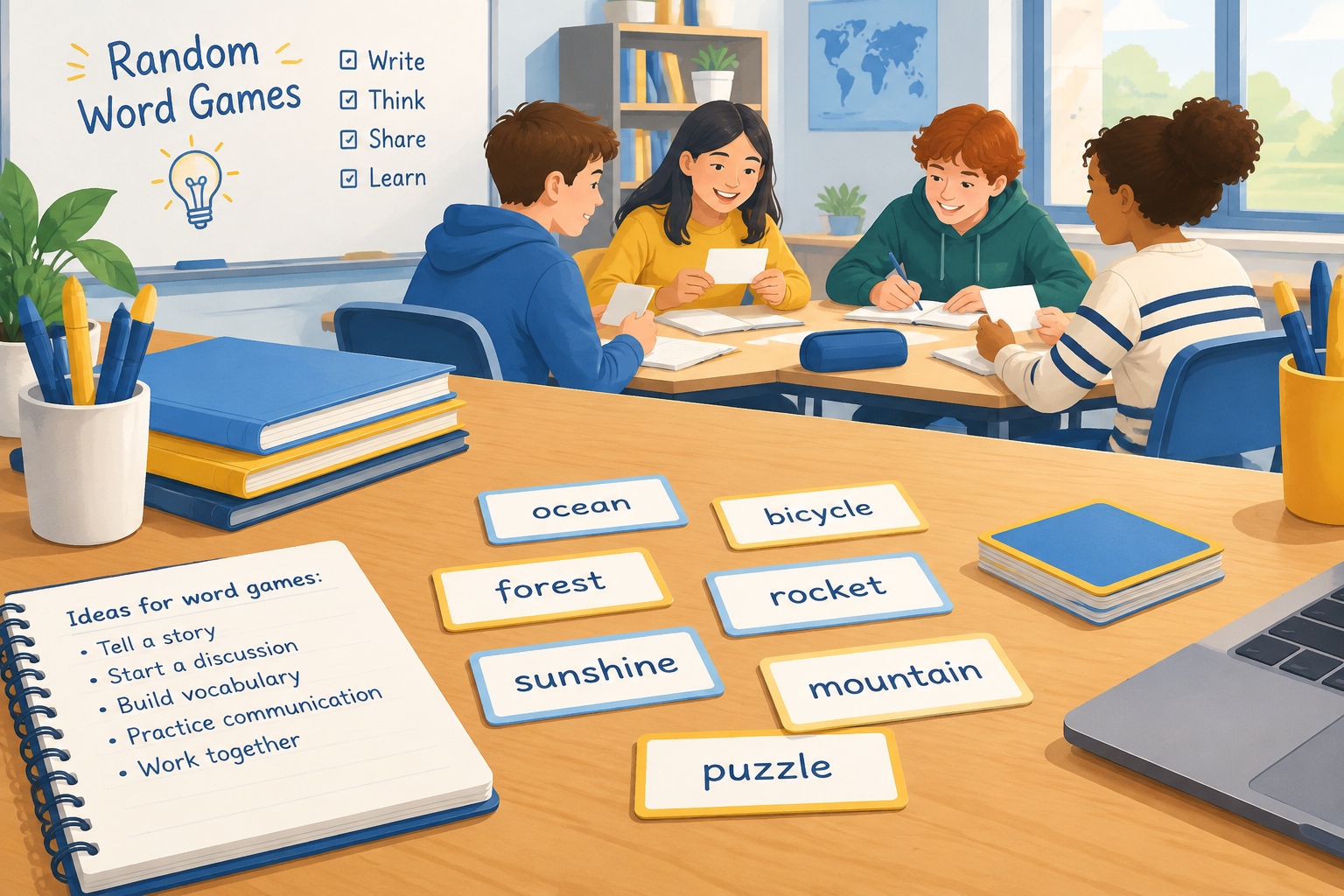
Random word games are a simple way to make classroom learning more interactive. A single unexpected word can inspire a story, start a discussion, create a vocabulary challenge, or help students practice communication skills. Teachers can use random words across many subjects, from language arts and foreign language learning to science reviews and creative projects.
A classroom does not need complicated materials to run an effective word game. With a list of words, a few rules, and a clear goal, students can practice thinking quickly while developing vocabulary and collaboration skills. A digital tool such as a random word generator can help teachers create fresh prompts whenever they need them.
This guide explores classroom word games, explains why they work, and provides practical examples teachers can adapt for different ages and learning environments.
Why Use Random Word Games in the Classroom?
Random word games encourage students to work with language instead of only memorizing it. When students receive an unfamiliar word or a surprising combination of words, they must analyze meaning, make connections, and communicate their ideas.
These activities can support several classroom goals:
- Vocabulary development: Students encounter new words and practice using them in context.
- Creative thinking: Random prompts encourage students to make unusual connections.
- Speaking practice: Games provide low-pressure opportunities for discussion and presentations.
- Writing improvement: Students learn to organize ideas around a prompt.
- Collaboration: Group activities require students to listen and build on each other's ideas.
Random word activities are also flexible. A teacher can use them as a five-minute warm-up, a full lesson activity, or a review exercise at the end of class.
How Teachers Can Use a Word Generator for Teachers
A word generator for teachers can save preparation time by producing quick classroom prompts. Instead of creating a new list before every lesson, educators can generate words on demand and adjust the activity based on student needs.
For example, a teacher might generate ten random nouns before a creative writing lesson. Students can choose three nouns and create a short story that connects them. In a speaking class, students might receive one random word and explain its meaning, describe a personal connection, or use it in a sentence.
Teachers can also combine different types of words. A noun generator can provide objects or concepts, while adjective and verb generators can add descriptive challenges. This creates more advanced activities where students build complete sentences or stories.
Useful classroom tools include:
- Random noun generator for objects, places, and ideas.
- Random verb generator for action-based writing prompts.
- Random adjective generator for descriptive vocabulary practice.
Classroom Word Games for Different Age Groups
Different age groups respond to different levels of challenge. Younger learners may benefit from visual and simple vocabulary games, while older students can handle abstract concepts and creative challenges.
Elementary Classroom Word Games
Younger students often enjoy games that involve movement, drawing, and storytelling. Random words can become playful learning tools when combined with pictures or team activities.
Examples include:
Word Drawing Challenge
Give students a random word and ask them to draw it within a limited amount of time. After drawing, students explain their picture to classmates. This activity helps connect vocabulary with visual memory.
Mystery Word Guessing
One student receives a random word without showing others. They describe the word using clues while classmates guess the answer. This encourages speaking skills and descriptive language.
Build a Sentence
Students receive several random words and work together to create a sentence using all of them. The challenge can be adjusted by requiring longer sentences or specific grammar structures.
Middle and High School Classroom Word Games
Older students can use random words for deeper analysis, debate, and writing practice.
Random Story Builder
Students receive several unrelated words and must create a short story connecting them. For example, words like "bridge," "storm," and "camera" can become the foundation for a mystery, adventure, or personal narrative.
The goal is not to create a perfect story immediately. The activity helps students practice planning, organization, and creative problem-solving.
Vocabulary Competition
Divide students into teams and provide a random word. Teams earn points by defining the word, using it correctly in a sentence, identifying synonyms, or explaining related concepts.
Debate Prompt Generator
A random word can become the starting point for a discussion. Students can explore questions such as how the word connects to society, technology, history, or personal experiences.
Creative Writing Activities With Random Words
Random words are especially useful for writing lessons because they remove the pressure of finding an idea from nothing. Many students struggle with starting a story, but a prompt gives them a direction.
Here are several writing activities teachers can try:
Three-Word Story Challenge
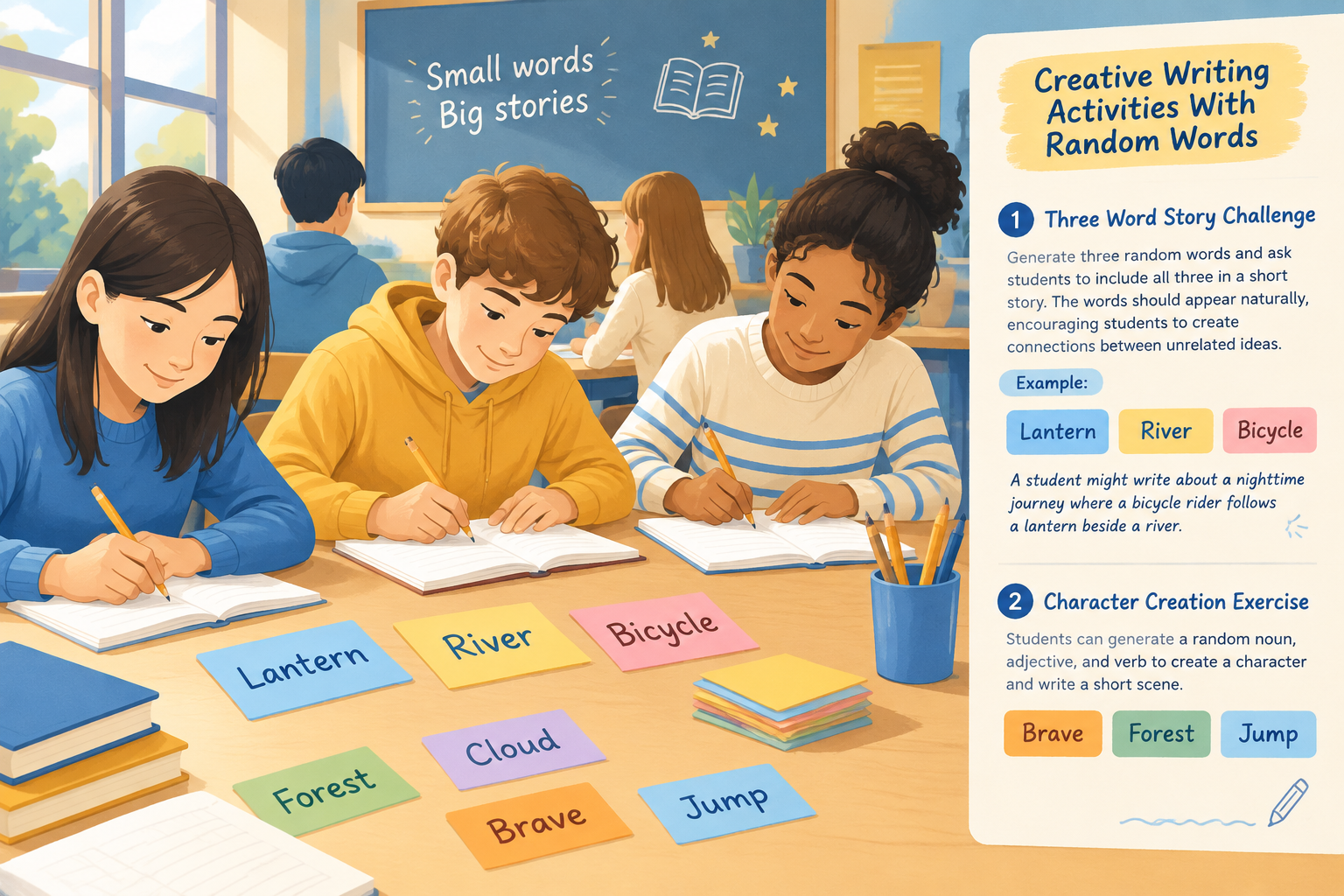
Generate three random words and ask students to include all three in a short story. The words should appear naturally, encouraging students to create connections between unrelated ideas.
Example:
- Lantern
- River
- Bicycle
A student might write about a nighttime journey where a bicycle rider follows a lantern beside a river.
Character Creation Exercise
Students can generate a random noun, adjective, and verb to create a character concept.
Example:
- Noun: inventor
- Adjective: curious
- Verb: explore
Students then describe the character's background, goals, and challenges.
Random Sentence Expansion
Start with a simple sentence generated from a random prompt. Students expand it by adding details about setting, characters, emotions, and events.
A basic sentence such as "The bird found a key" can become a longer narrative with richer vocabulary.
Fun Group Games Using Random Words
Group activities help students learn from each other. Random word games can be adapted for teams, pairs, or whole-class participation.
Word Chain Game
The first student says a random word. The next student must say another word connected to it. The chain continues until students cannot create a connection.
Teachers can make this more challenging by requiring specific categories, such as animals, scientific terms, or vocabulary from a current lesson.
Pictionary-Style Word Game
Students draw random words while teammates guess. Teachers can create customized word lists based on current topics. A dedicated Pictionary word generator can help create quick prompts.
Acting and Charades
Students act out words without speaking while classmates guess. A charades generator can provide a steady supply of ideas for classroom games.
Word Relay
Teams compete to write words that match a category. For example, students might list as many words as possible related to nature, emotions, or technology.
Tips for Making Random Word Games Effective
Random word games work best when teachers connect them to clear learning objectives. A game should not only be entertaining; it should help students practice a skill.
Consider these strategies:
Match Words to the Lesson
Random does not always mean unrelated. Teachers can limit word choices to a topic being studied. A science class might use random words related to ecosystems, while a history class might focus on important concepts from a unit.
Adjust Difficulty Levels
Younger students may need familiar words, while advanced learners may benefit from abstract vocabulary. The same game can be changed by selecting easier or more challenging words.
Encourage Multiple Answers
Creative activities are more successful when students understand that there can be many possible solutions. Avoid focusing only on one correct response during brainstorming exercises.
Combine Digital and Offline Activities
Teachers can use online generators for preparation while keeping the classroom activity interactive. Digital tools provide quick inspiration, but discussion and collaboration create the learning experience.
Using Random Words Across Subjects
Random word games are not limited to English classes. Teachers in many subjects can use them as review or engagement activities.
Science
Students can explain relationships between random scientific terms, create hypothetical experiments, or describe a process using selected words.
Mathematics
Students can create word problems using random objects or situations. This helps connect mathematical concepts to real-world contexts.
Social Studies
Students can connect random historical terms and explain possible relationships between events, people, or ideas.
Language Learning
Students can practice translation, pronunciation, sentence building, and conversation using generated vocabulary.
Frequently Asked Questions About Random Word Games for the Classroom
What are random word games?
Random word games are activities that use unexpected words as prompts for learning, creativity, speaking, writing, or problem-solving. Teachers can use them for vocabulary practice, storytelling, discussions, and review activities.
How can teachers use a random word generator in class?
Teachers can use a random word generator to quickly create prompts for writing exercises, vocabulary games, speaking activities, and group challenges. The generated words can be adapted to match a lesson topic or student level.
Are random word games suitable for all ages?
Yes. The activity format can be adjusted for different age groups. Younger students may use drawing and simple sentence activities, while older students can complete debates, stories, and complex vocabulary challenges.
How many words should students receive for a writing activity?
The ideal number depends on the activity. Beginners may work well with one to three words, while advanced writers may enjoy challenges involving five or more words.
Can random word games support vocabulary learning?
Yes. When students use new words in meaningful sentences, conversations, or stories, they practice understanding and applying vocabulary rather than only memorizing definitions.
Try Random Word Games in Your Next Lesson
Random word games are an easy way to add creativity and participation to classroom activities. Whether you need a quick warm-up, a writing prompt, or a team challenge, random words can help students explore ideas in new ways.
For a fast source of classroom prompts, try the random word tool and create your next vocabulary activity in seconds.
FAQ
Are the words classroom-safe?
Yes. The corpus is a curated general-English word list, and the common-words mode sticks to familiar vocabulary suitable for school use.
Can I reuse the same list across groups?
Yes — copy or export the list so every group works from the same prompts.
Does it work on shared classroom devices?
Yes. The tools run in any modern browser with no accounts, so a shared tablet cart is enough.