10 Word Games Like Wordle to Play Every Day
If today's Wordle is already solved and you are still hunting for games like Wordle, the good news is that the genre has grown well past five grey squares. There are Wordle alternatives built around maths, meaning, geography, and live multiplayer races — and most of them are free, browser-based, and designed to be played once a day.
This guide walks through ten daily word games worth adding to your routine, explains what each one actually asks of you, and offers practical notes on fitting them into a short morning break or a classroom starter. Each entry points at the specific constraint that tends to trip players up, rather than vague encouragement.
What Makes a Game "Like Wordle"?
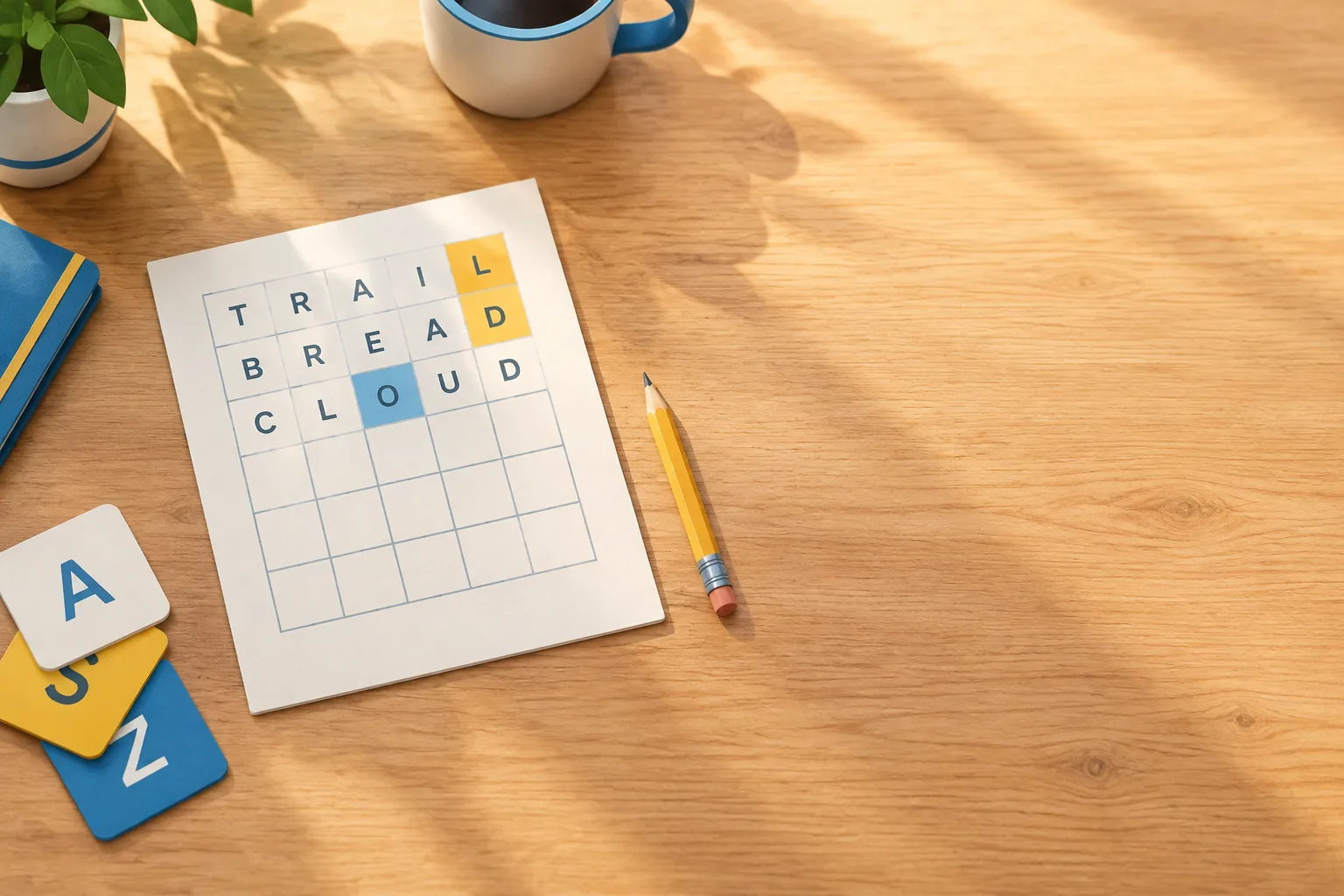
Before the list, it helps to name the ingredients. Almost every game below shares at least two of them.
The daily rhythm
Part of Wordle's pull is scarcity. One puzzle per day, resetting at midnight local time, means the game ends before it becomes a chore. Many alternatives copy this deliberately — some even keep a streak counter that penalises you for missing a day.
A guessing loop with feedback
You commit to an answer, the game tells you how close you were, and that feedback reshapes your next guess. In Wordle the feedback is colour-coded letters. In Semantle it is a semantic similarity score. In Connections it is whether your group of four survives.
A small, fixed budget
Six guesses, nine guesses, fifteen swaps — the limit is what turns a guessing game into a puzzle. When a clone removes the limit, the tension usually goes with it.
Free, no-install play
The overwhelming majority of these games run in a browser tab. There is nothing to download, and no account is needed for the base puzzle.
1. Quordle — Four Boards, One Guess
Quordle asks you to solve four five-letter words at once, and every guess you type is applied to all four boards simultaneously. You get nine attempts rather than six.
The strategy shift is real. A word that is a strong opener in Wordle can be a wasted guess here if it only lights up one board. Experienced players open with words that cover many common letters, then spend the middle guesses triaging whichever board is furthest behind.
2. Squabble — Wordle as a Real-Time Race
Squabble turns the puzzle into a battle royale. Everyone in a match receives the same hidden word, guesses resolve for all players at once, and solving the word early costs your opponents health. Lose all your health and you are out.
Because the clock runs in real time, Squabble rewards speed over elegance. If you normally agonise over your third guess, this is a good game for practising faster, more decisive play.
3. Dordle — Two Words, Seven Guesses
Dordle is the minimalist version of Quordle: two words, seven guesses, shared feedback. It is a reasonable next step if six guesses on a single board feels too easy but four boards feels like homework.
The most common mistake is treating the two boards as separate puzzles. They are not. A guess that solves nothing on the left board but constrains the right one is still a productive guess.
4. Semantle — Guess by Meaning
Semantle throws letters out entirely. You type any word, and the game tells you how semantically close it is to the secret word on a scale that runs cold up to 1000 for an exact match. The ranking reflects how often words appear near each other in large bodies of text, not how they are spelled.
This means you can be one letter away from the answer and still get a terrible score, or be nowhere near it phonetically and score 900. Semantle is the best of these games for building vocabulary breadth, because it forces you to think in topics and associations rather than letter patterns.
5. Contexto — Similar Idea, Different Feel
Contexto uses the same closeness idea but gives you a ranked list of your guesses, so you can see the shape of the space you are searching. Instead of a raw score, you watch your words climb a leaderboard toward the secret term.
Both Semantle and Contexto are excellent warm-ups for writing sessions. Spending five minutes hunting for a concept by association is remarkably close to the work of finding the right word inside a paragraph.
6. Nerdle — The Numbers Version
Nerdle swaps letters for digits. You guess a complete, mathematically valid equation, and the familiar colour feedback tells you which characters are correct, misplaced, or absent.
It is not a word game, but it belongs on this list because it scratches the same itch and because it is a genuinely useful classroom tool. Students who freeze at spelling puzzles often relax completely when the tiles are numbers.
7. Waffle — Untangle the Grid
Waffle presents a waffle-shaped grid of letters and asks you to swap tiles until every row and column forms a real word. You get a limited number of swaps, and the game shows you how many of the six words are already correct.
Waffle is the closest thing here to a physical letter-tile puzzle. It rewards scanning for the words that are nearly complete and fixing those first, rather than swapping at random.
8. Absurdle — The Game That Cheats Back
Absurdle is an adversarial Wordle. There is no secret word chosen in advance. Instead, the game maintains a pool of every word consistent with the feedback it has given you so far, and each time you guess it picks a response that keeps the largest possible pool alive. It will string you along for as long as it legally can.
Play it to understand how much information your guesses actually carry. A word that feels clever can produce feedback so uninformative that the pool barely shrinks.
9. Spelling Bee — Seven Letters, Many Words
Spelling Bee gives you seven letters and asks you to build as many valid words as you can, with two rules: every word must use the centre letter, and words must be at least four letters long. A word that uses all seven letters is a pangram.
Where Wordle is a sprint, Spelling Bee is a slow wander. It is the best game on this list for expanding vocabulary in a low-pressure way, and it is easy to play in short bursts between other tasks.
10. Connections — Group the Words
Connections hands you sixteen words and asks you to sort them into four groups of four, with categories that range from obvious to deliberately misleading. You get four mistakes before the puzzle ends.
Connections is a categorisation game rather than a spelling game, which makes it a good complement to the rest. If your letter-guessing is strong but your topic knowledge is thin, this one will find the gap quickly.
How to Build a Daily Routine
A ten-minute stack
Quordle or Dordle first, while your brain is fresh. Then Wordle, then Connections. Save Semantle or Contexto for a coffee break, since they reward loose, associative thinking rather than precision.
When you get stuck
Do not stare at the grid. Write out the letters you have confirmed, list candidate words by hand, then test the ones that place common letters in new positions. If you are building your own puzzle or a classroom round, a random word generator is a fast way to produce a pool of candidate words, and a random noun generator helps when you want themed rounds instead of generic ones.
One puzzle a day, not five
The daily limit is a feature. Playing the same puzzle across five clone sites flattens the challenge into repetition.
Using These Games in the Classroom
Games like Wordle work well as a five-minute starter because the rules take under a minute to explain and every student can contribute a guess.
A few practical notes:
- Project the board and take guesses from the class. Vote on the guess rather than letting the loudest student decide.
- Ask for reasoning, not just answers. "Why that word?" turns a guessing game into a vocabulary discussion.
- For custom rounds, build a word list in advance so you control the difficulty. A Wordle-style word generator can supply five-letter answers if you want to run your own version of the puzzle.
- Keep it short. Once the puzzle stops being a warm-up, it becomes a time sink.
- Rotate the game type. Letter games, number games, and category games surface different students' strengths.
Tips That Transfer Across All Ten Games
- Open with a word that spreads letters out. Vowels and common consonants in varied positions give more information than a word with repeated letters.
- Treat guesses as experiments. A guess that cannot possibly be the answer is still valuable if it eliminates a lot of options.
- Track what you have ruled out. Most losses come from forgetting a letter was already excluded.
- Play at the same time each day. Habit turns the daily puzzle into a two-minute task rather than a ten-minute one.
- Accept the loss. Every one of these games has a losing state on purpose, and that is what makes winning mean something.
FAQ
What are the best games like Wordle for beginners?
Start with Dordle, then move to Quordle once two boards feel comfortable. Waffle is also beginner-friendly because the grid shows you how many words are already solved. Save Semantle, Contexto, and Absurdle for later, since they punish unstructured guessing.
What is the best free alternative to Wordle?
It depends on what you want. Quordle is the closest in feel and difficulty. Semantle and Contexto are the best options if you want something completely different. All of the games listed here are free to play in a browser.
Can I play more than one Wordle per day?
The official Wordle publishes one puzzle per day. If you want more, the alternatives above are the practical route — Quordle, Dordle, and Squabble all give you additional rounds without repeating the same board.
Are Wordle-style games useful in the classroom?
Yes, as a short vocabulary warm-up. They work best when you ask students to explain their guesses and keep the round to five minutes. For custom rounds, generate your own answer list so you can control the difficulty.
What is a good starting word for these games?
Look for a word with two or three vowels and common consonants in different positions. Avoid words with repeated letters as a first guess, because they tell you less about the letters you have not tried yet.
How is Semantle different from Wordle?
Semantle scores your guess by meaning rather than spelling. You can be nowhere close in letters and still score highly, or one letter away and score badly. That makes it a vocabulary game rather than a letter-pattern game.
Can I make my own Wordle-style puzzle?
Yes. The simplest approach is to choose a five-letter answer, write it down, and have players guess against it. For repeated classroom use, keep a generated list of five-letter words handy so you never repeat an answer by accident.
Do these games need an account or an app?
Almost all of them run in a browser without an account. Some offer optional accounts for streaks and statistics, but the daily puzzle is normally playable without signing in.
Build Your Own Daily Word Game Habit
The appeal of Wordle was never the graphics — it was the ritual. Pick two or three of the games above, play them at the same time each morning, and you get the same small, satisfying puzzle break without waiting until midnight.
If you want to extend the habit into writing or teaching, the random word generator and random noun generator on this site can produce fresh word lists for practice rounds, creative writing prompts, and classroom puzzles — so the game does not have to end just because today's answer is already solved.