
Pictionary Words for Kids: Easy Drawing Word List by Grade
The best pictionary words for kids are the ones a child can sketch in a few strokes and a teammate can guess before the timer runs out. That sounds obvious, but most homemade word lists fail on one of two points: the word is too abstract to draw ("friendship"), or it is too unfamiliar for the age group ("abacus"). This guide gives you a pictionary word list for kids organized by grade band, plus the rules and troubleshooting notes that keep a game moving when a mixed-age group is playing.
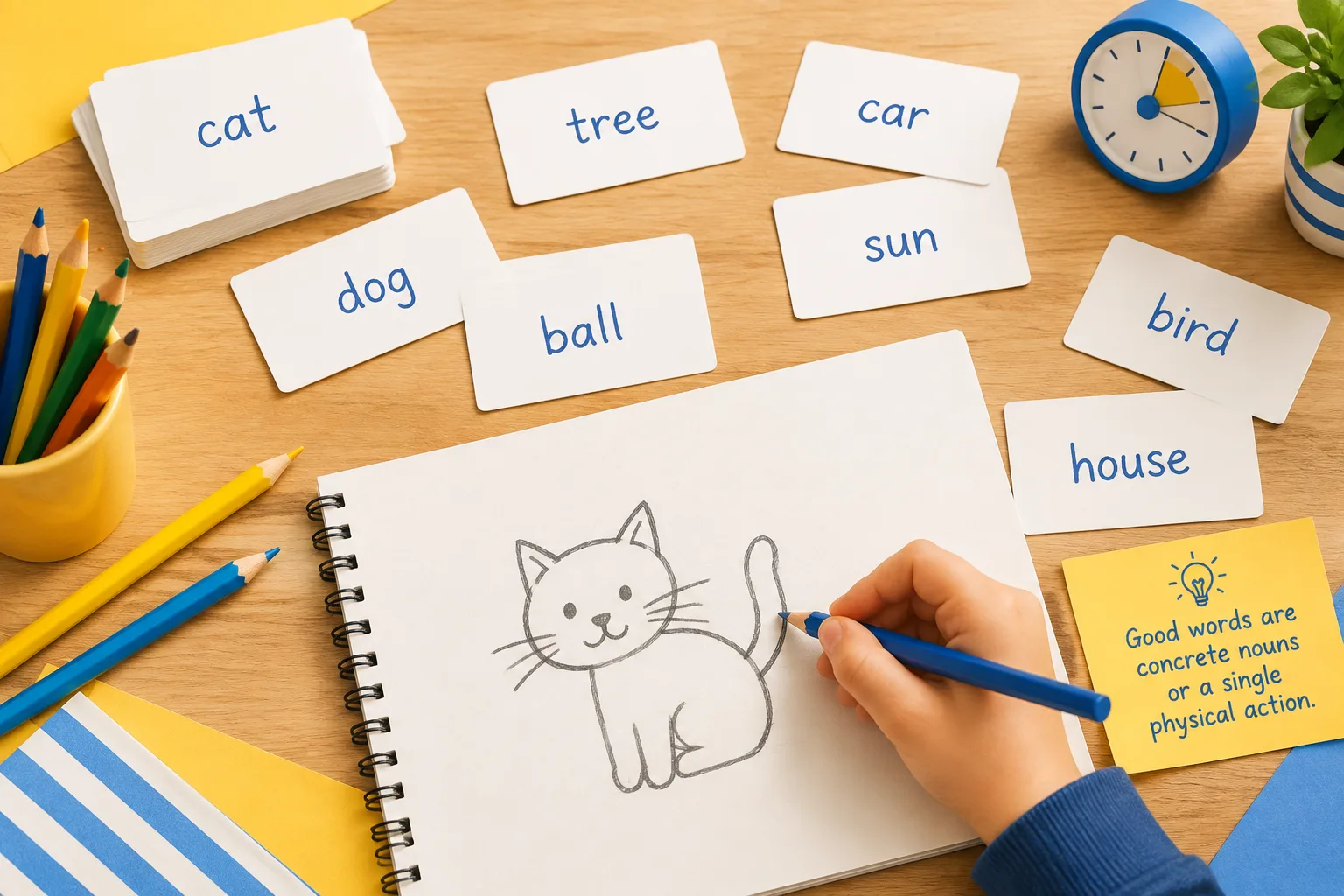
If you only remember one thing, remember this: a good card is a concrete noun or a single physical action. Everything else in this article is about sorting those words by difficulty.
What Makes a Word Good for Kids' Pictionary
Before you write a single card, run candidate words through four filters.
- It is a concrete noun or a visible action. "Volcano" yes. "Bravery" no.
- It has one clear silhouette. "Tree" and "flower" read instantly. "Forest" is vague.
- The child already knows the word. A drawing game tests drawing and guessing, not vocabulary recall. If a seven-year-old has never heard "metronome," the card is dead weight.
- It cannot be confused with another card in the same deck. Do not put "cat" and "kitten" in the same round. Pick one.
There is also a rules constraint that surprises people: in the classic game, the drawer may not write letters or numbers. So any word that is easiest to convey with writing — "seven," "TV," "OK" — is a bad card no matter how easy the concept is.
The Three-Second Test for Easy Pictionary Words
When you are deciding between two words, sketch both on scrap paper and time yourself. If you cannot produce something recognizable in about three seconds of drawing, the word belongs in a harder tier or in the discard pile.
A useful follow-up question: could a teammate guess this from the first two lines? If the answer is no, the word is fine for older kids but frustrating for early elementary. Difficulty in Pictionary comes from drawing ambiguity, not from word rarity.
Easy Pictionary Words for Kids: Kindergarten to Grade 2
At this age, keep rounds short and words extremely familiar. Twenty to thirty cards per session is plenty — a longer deck mostly means more skipped turns. Speak the word aloud for pre-readers so reading ability never blocks the game.
Animals and nature
cat, dog, fish, bird, bee, frog, duck, snake, mouse, elephant, ladybug, sun, tree, flower, cloud, star, moon, leaf, rainbow, snowman
Food and everyday objects
apple, banana, cake, pizza, ice cream, egg, carrot, cookie, cup, spoon, chair, bed, house, key, ball, book, hat, shoe, umbrella, clock
Simple actions and people
run, jump, sleep, swim, cry, laugh, sing, dance, baby, doctor, teacher, clown, king, witch, robot
Notice that every word here can be drawn as a single object or a stick-figure action. That is the whole design principle of the easy tier.
Pictionary Word List for Kids in Grades 3–5
This is the sweet spot for most classrooms. Kids have a bigger vocabulary, they can hold a drawing idea in their head longer, and they enjoy slightly trickier prompts.
Trickier nouns
volcano, lighthouse, cactus, dinosaur, octopus, astronaut, castle, dragon, windmill, waterfall, skateboard, mailbox, headphones, popcorn, sandwich, toothbrush, mermaid, campfire, hammock, jellyfish, telescope, submarine, treasure chest, snow globe
Actions that need a bit of acting
juggling, snorkeling, fishing, skateboarding, sneezing, hiccuping, yawning, gardening, painting, knitting, surfing, ice skating, reading a map
Compound nouns — "popcorn," "snowman," "rainbow" — are unusually strong cards because they can be drawn as two simple parts stacked together. Keep a handful of them in every deck as confidence builders.
Harder Tier: Pictionary Words for Grades 6–8
Older players still want drawable words, but they appreciate puzzles with a twist: compound ideas, mini-scenes, and concepts that can be shown rather than spelled.
- Concepts with a visual metaphor: gravity, eclipse, echo, mirage, maze, iceberg, avalanche, traffic jam
- Time and technology: alarm clock, hourglass, compass, escalator, solar system, roller coaster, hot air balloon
- Mini-scenes (still one guess): sunburn, exam, orchestra, camping trip, birthday party, tooth fairy
Mini-scenes are the natural bridge to adult Pictionary. They are harder because the drawer has to choose which detail matters — which is exactly the skill the game is training.
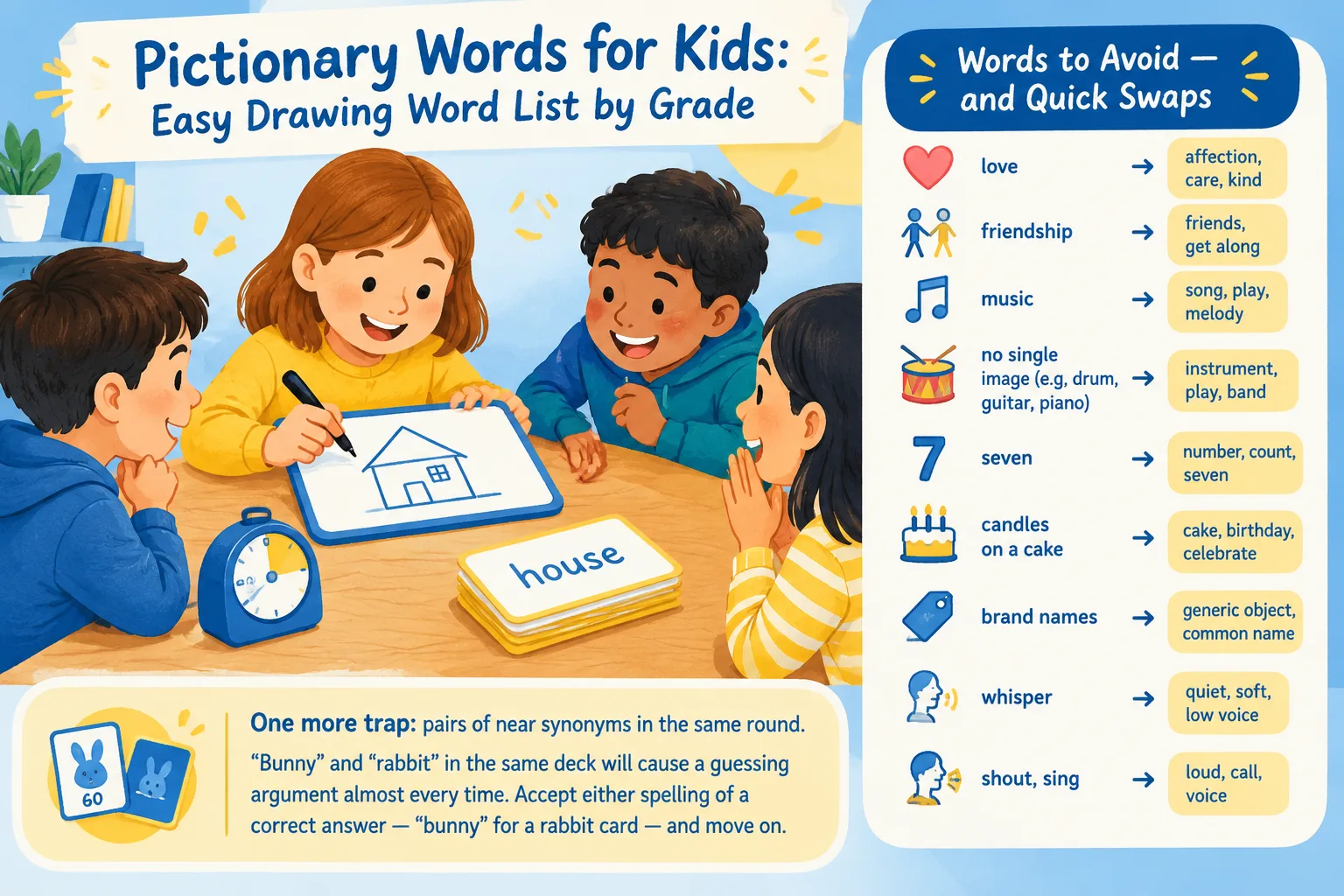
Words to Avoid — and Quick Swaps
| Avoid | Why | Swap with |
|---|---|---|
| love | abstract, no silhouette | heart |
| friendship | abstract | two stick figures holding hands |
| music | no single image | drum, guitar, piano |
| seven | needs a written number | seven candles on a cake |
| brand names | narrow and often unfamiliar | the generic object |
| whisper | silent and invisible | shout, sing |
One more trap: pairs of near-synonyms in the same round. "Bunny" and "rabbit" in the same deck will cause a guessing argument almost every time. Accept either spelling of a correct answer — "bunny" for a rabbit card — and move on.
How to Set Up a Fair, Fast-Moving Game
Teams and roles
Two teams of two to four players works best for kids. One player draws per turn, then rotates out, so everyone gets a turn at the board. The drawer may not talk, gesture, or mouth the word; the guessing team calls answers out loud.
Timing
Sixty seconds per card is right for kindergarten through grade 2. Grades 3 and up can handle 90 seconds. Longer timers do not make the game better — they just make it slower.
House rules worth writing down
- No letters, no numbers, no words written on the paper.
- One skip per turn, then the drawer must commit to the next card.
- Synonyms count. "Bunny" scores for a rabbit card.
- Keep a discard pile so a word never repeats in the same game.
Scoring variations
The simple version is one point per correct guess. If you want a livelier game, add a bonus point when the guess lands in the first 15 seconds, or let the other team "steal" a point if they guess a skipped card within ten seconds.
Adapting the Same List for Classrooms, ESL, and Family Night
Classroom vocabulary review. Replace your usual quiz with a drawing round using words from the current reading or science unit. It works because the drawer has to translate meaning into image, which surfaces misunderstandings you would not catch on a worksheet.
ESL and early readers. Start with the kindergarten tier and say the word aloud. Pair each word with a picture card first, then remove the picture and play. Concrete nouns like "apple" and "umbrella" transfer across languages far more easily than verbs.
Family night with mixed ages. Print three decks in different colors — easy, medium, hard — and let each team draw from the deck that matches its youngest player. Mixed teams can choose one card from each deck per turn.
Quiet or travel version. One person draws on paper and everyone else writes guesses on sticky notes. The first correct note wins the point. No shouting required.
Building Cards and Randomizing Your Word Pools
Handwritten cards work fine, but the lists get stale after a few game nights. Two practical options:
- Keep a master list in a document, grouped by category, and shuffle it before each session.
- Generate fresh drawable nouns with a random word generator, then filter to nouns and sort into easy, medium, and hard piles. If you need objects specifically, a random noun generator gives you a clean noun pool to start from.
For a themed game night, a pictionary word generator lets you pull a card on the spot instead of printing anything. Whatever route you take, review the output before playing — random lists always include a few words that need a swap.
Quick Troubleshooting
The drawer freezes. Let the team offer one category hint ("animal," "food"). If the timer still runs out, the card goes back in the pile.
A guess is close but not exact. Accept it if it names the same object. Reject it if it is a different object in the same category — "dog" does not score for a wolf card.
A younger player keeps losing. Give them the easy deck exclusively for a round. Confidence matters more than fairness in a five-minute game.
Someone starts writing. The card is void and the turn passes. Say this rule once at the start and it almost never comes up again.
The same word keeps coming back. Shuffle less; instead, deal from the top of a single shuffled stack and keep used cards face down.
FAQ
What are good pictionary words for kids?
Concrete nouns and single actions that the child already knows: animals, foods, household objects, weather, and simple verbs like jump, swim, or sleep. If a word needs a written label to make sense, it is not a good card.
How many words do I need for one game?
Twenty to thirty cards is enough for a 20-minute session with young kids. Older players can work through fifty or more because their turns run faster.
What are the easiest pictionary words for kindergarteners?
Start with sun, tree, cat, dog, house, ball, apple, star, and flower. These have a single recognizable outline and need no fine detail.
How do you play with kids who cannot read yet?
Show or whisper the word to the drawer while the guessing team looks away. Pre-readers can draw perfectly well; reading is the only barrier, and it is easy to remove.
Can I reuse one word list across different ages?
Yes, if you sort it into tiers. The same deck works for grades 3–5 and grades 6–8 as long as you put the abstract, mini-scene cards in the upper tier and keep concrete nouns in the lower one.
What if a card turns out to be too hard for my team?
Use the one-skip rule. Keep a running note of cards that were skipped twice and remove them from the deck before the next session.
Build Your Next Word List in a Minute
You do not need a perfect printed deck to start playing tonight. Pick a grade band from this guide, pull twenty words, and deal them out. When the list feels tired, generate a fresh batch with the random word generator, skim for anything undrawable, and you are ready for another round.