
Vocabulary Words by Grade Level: Word Lists for K–8
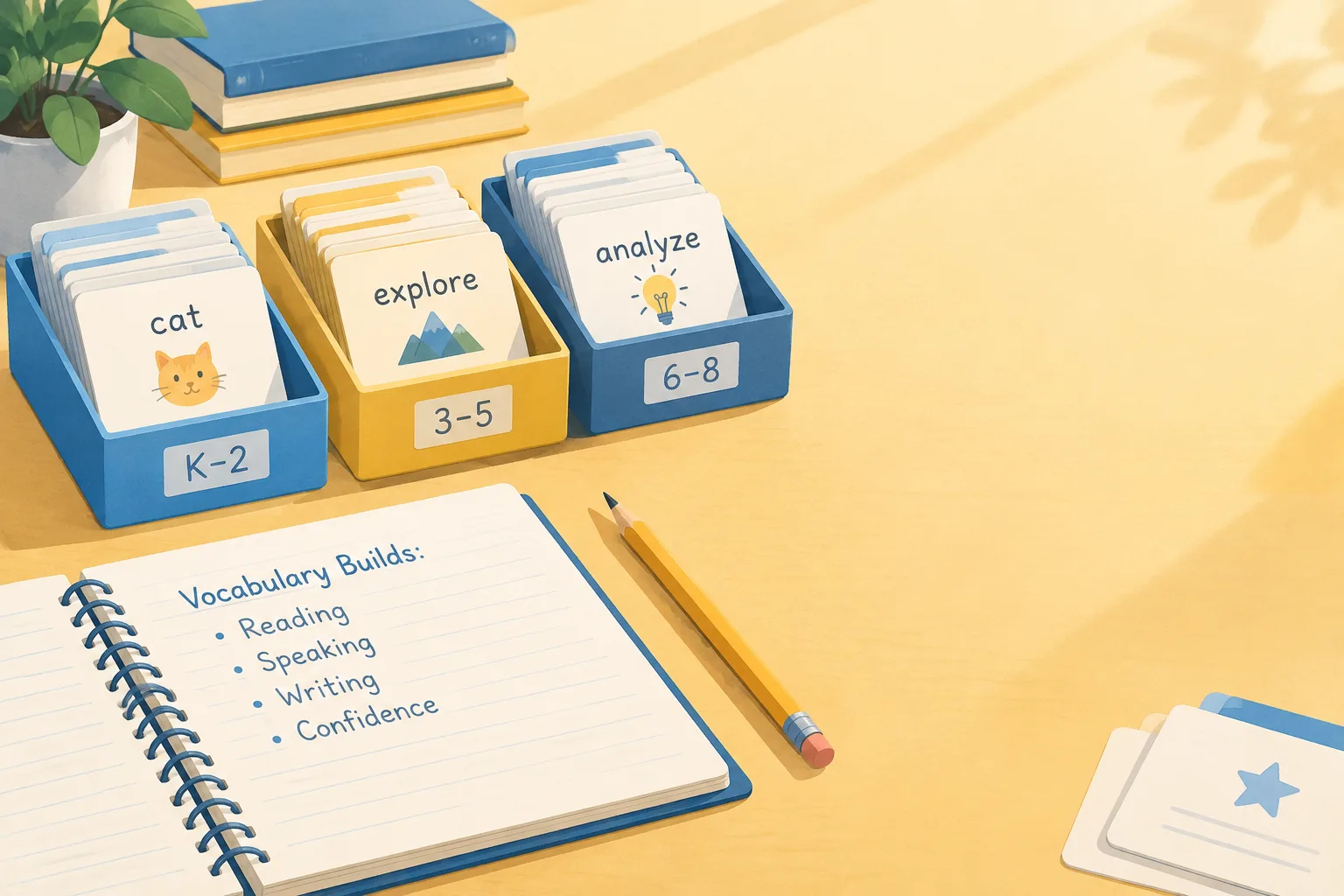
Vocabulary words by grade help teachers, parents, and tutors see what a student is likely to read, say, and write at each stage of school. No single list is universal — grade vocabulary words shift with state standards, district curriculum, and the books a class actually reads — but the progression is predictable. Kindergarten and first grade lean on short, concrete, high-frequency words. By middle school, students are expected to handle abstract academic terms and subject-specific language. This wiki explains how grade-level lists are built, gives a sample vocabulary word list for each band, and shows practical ways to use those words in class, at home, or in word games.
Why Schools Organize Vocabulary by Grade
Vocabulary instruction is tied to reading comprehension: readers who recognize more words spend less effort on decoding and more effort on understanding. That is why most curricula sequence words instead of presenting them alphabetically or randomly. A list sorted by grade answers three planning questions at once: which words are worth teaching now, which can wait, and which words students probably already know well enough to skip.
Grade placement is also a practical compromise. A second grader in one district may meet habitat while another meets it in fourth grade. The word is not inherently "a second grade word" — the surrounding unit, the text difficulty, and the standards decide when it appears.
How Grade Vocabulary Words Are Organized
Most vocabulary word lists used in K–8 classrooms draw on four overlapping frameworks.
The three-tier model
- Tier 1 — everyday, conversational words: run, happy, big, friend. Most students pick these up through talking, so they rarely need formal instruction.
- Tier 2 — general academic words used across subjects: compare, evidence, contrast, summarize, significant. These carry the highest instructional value because they appear in science, social studies, and language arts alike.
- Tier 3 — domain-specific terms: photosynthesis, denominator, latitude, metaphor. Tier 3 words are usually taught inside a specific unit, when the content requires them.
Sight-word and high-frequency lists
Primary grades often layer in Dolch or Fry style high-frequency words — short words such as the, said, come, because that appear constantly in early readers. These overlap with Tier 1 but are tracked separately, because the goal is automatic recognition rather than deep meaning work.
Academic and content-area vocabularies
Upper elementary and middle school lists pull from two directions: general academic word families found in published academic word lists, and the glossaries of each subject. A sixth grader might meet analyze in English, variable in math, and migration in social studies in the same week.
Standards and local lists
State standards tend to describe skills — for example, using context or word parts to work out an unknown word — rather than naming exact words. Districts and publishers then produce the actual lists. That is why two "5th grade vocabulary lists" may share only about half their words, and why comparing lists is more useful than trusting any single one.
Kindergarten to Grade 2: Building the First Word Bank
Early lists are concrete, sensory, and easy to illustrate:
- Nouns: dog, apple, chair, rain, school, family
- Action words: jump, whisper, share, build, hide
- Describing words: soft, loud, tiny, wet, brave
- Position and direction: above, between, behind, next to
- Feelings: proud, worried, excited, calm
At this stage, oral language comes first. A five-year-old may understand enormous long before spelling it. Picture cards, gestures, and sentence frames ("The elephant is enormous because ___") do more work than written definitions. Keep the written list short and reread it often.
Grades 3–5: From Decoding to Meaning
By third grade, students are reading to learn, and lists become more abstract:
- Morphology: preview, disagree, reusable, careless, bicycle
- Multiple-meaning words: bat, spring, light, table, order
- Transition and signal words: however, finally, therefore, meanwhile
- Character and story words: curious, reluctant, generous, persuaded
- Content starters: habitat, erosion, fraction, colony, energy
This is the band where word parts pay off. Teaching -less, -ful, re-, and pre- gives students a way into dozens of unseen words, which is far more efficient than memorizing one word at a time. Multiple-meaning words deserve explicit attention too, since a reader who only knows one sense of spring or light will stumble.
Grades 6–8: Academic and Content-Area Vocabulary
Middle school lists shift toward precision and abstraction:
- Abstract nouns: consequence, perspective, influence, bias, responsibility
- Precise verbs: analyze, evaluate, imply, justify, convey, reinforce
- Greek and Latin roots: chron- (time), bio- (life), -logy (study), dict- (say)
- Tone and argument words: neutral, sarcastic, dismissive, compelling
- Subject terms: variable, ratio, cell membrane, amendment, symbolism
Students at this level can handle student-friendly definitions, examples and non-examples, and word relationships such as synonyms, antonyms, and analogies. They can also begin tracking words they meet in independent reading — a habit that carries into high school far better than a weekly quiz.
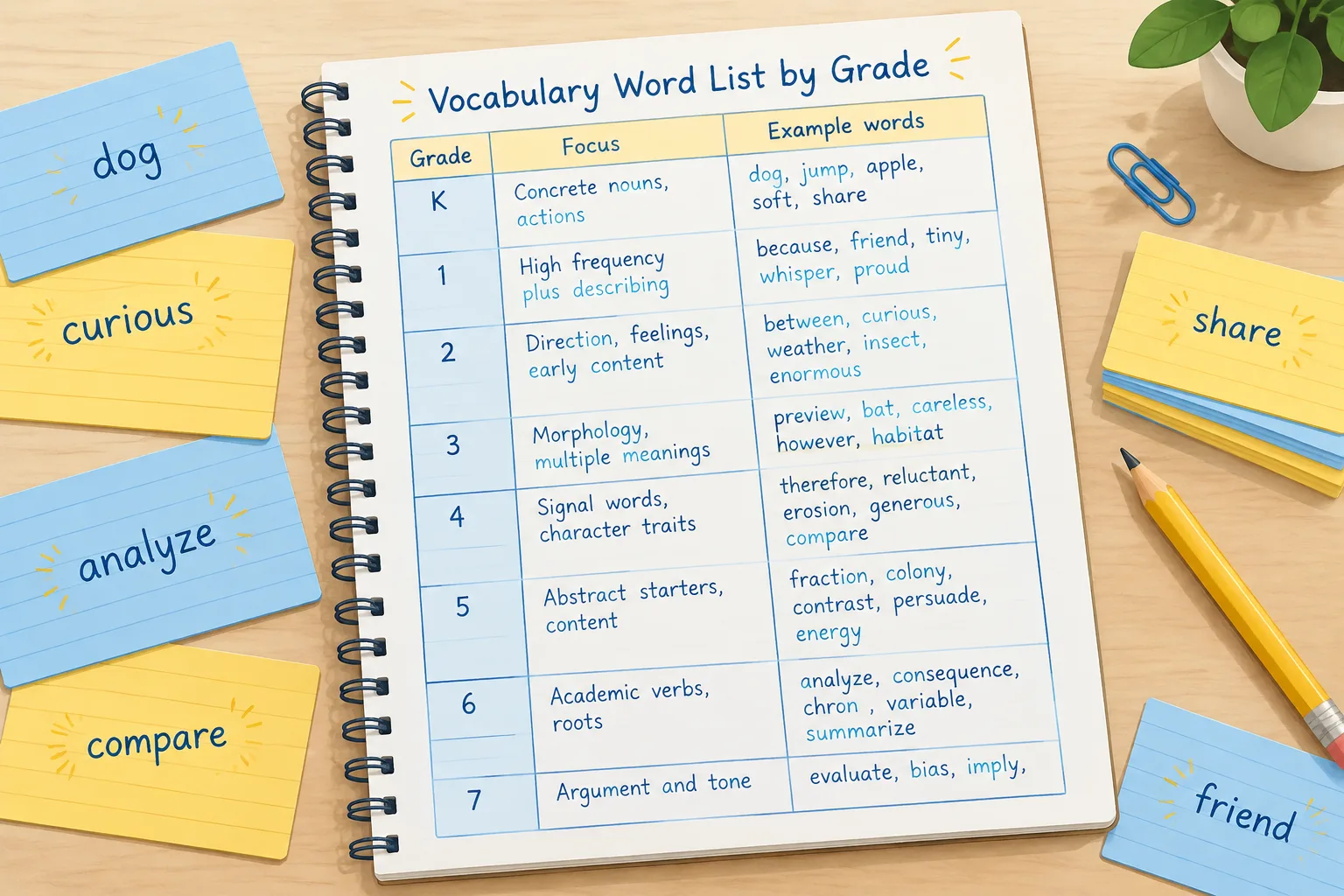
Sample Vocabulary Word List by Grade
The table below is illustrative, not official. Use it as a starting point, then remove words your students already know.
| Grade | Focus | Example words |
|---|---|---|
| K | Concrete nouns, actions | dog, jump, apple, soft, share |
| 1 | High-frequency plus describing | because, friend, tiny, whisper, proud |
| 2 | Direction, feelings, early content | between, curious, weather, insect, enormous |
| 3 | Morphology, multiple meanings | preview, bat, careless, however, habitat |
| 4 | Signal words, character traits | therefore, reluctant, erosion, generous, compare |
| 5 | Abstract starters, content | fraction, colony, contrast, persuade, energy |
| 6 | Academic verbs, roots | analyze, consequence, chron-, variable, summarize |
| 7 | Argument and tone | evaluate, bias, imply, neutral, migration |
| 8 | Precision and perspective | justify, perspective, convey, amendment, symbolism |
How to Use These Lists in Class and at Home
Five-minute routines
- Word of the day with a twist: give the word, one example, one non-example, then ask for a sentence about the room you are in.
- Sorting: write eight words on cards and sort by part of speech, meaning, or tone.
- Sentence upgrade: take a plain sentence ("The dog ran") and rebuild it using two words from the list.
- Two-minute recall: cover the list and ask for as many words as a student can say with a definition or example.
Word games and random prompts
Word games work because they force quick, repeated retrieval. Charades for action words, "which one doesn't belong" for categories, and story-building with a fixed number of words are all low-prep and reusable. When you need a fresh prompt, a random word generator supplies words instantly, and a random noun generator is handy for concrete-noun practice in K–2. Many of the routines in our vocabulary activities collection can be paired with any list on this page.
One caution with generated words: check them before class. Set the difficulty or word type, skim the output, and remove anything off-topic, ambiguous, or not age-appropriate. The generator is a prompt source, not a substitute for judgment.
Differentiation
Give the same text with different word targets. Students who need support work with a few Tier 2 words and sentence frames; students ready for more work with morphology and analogies. English learners often benefit from picture support, cognates, and first-language connections, especially for Tier 3 terms.
Common Mistakes with Grade-Level Vocabulary Lists
- Teaching Tier 1 words as if they were new. If everyone in the room knows happy, that lesson time is wasted.
- Front-loading twenty words before reading. A long pre-teaching list turns reading into a memorization task.
- Definition-only instruction. Copying a dictionary entry rarely transfers to actual use.
- One exposure. Words need repeated meetings in different contexts — reading, speaking, writing, and play.
- Ignoring word parts. Morphology multiplies the return on every word you teach.
- Treating a grade list as a gate. A list is a planning tool; students should not be blocked from interesting words because of their grade level.
FAQ
What are vocabulary words by grade?
They are words grouped by the school year in which they are typically introduced, based on reading level, standards, and curriculum. A vocabulary word list for one grade usually blends high-frequency words, general academic words, and a few content terms tied to that year's units.
Is there one official national vocabulary list by grade?
No. Standards describe skills rather than fixed words, so the lists you find online come from districts, publishers, and long-standing reference lists such as Dolch, Fry, or published academic word lists. Treat any single list as a suggestion.
How many new words should a student work with at a time?
Rather than a fixed number, the practical rule is fewer words with more encounters. Classrooms often focus on a handful of target words and revisit them across reading, speaking, and writing. Six words used six ways usually stick better than thirty words seen once.
Can I use a random word generator to teach vocabulary?
Yes. It is useful for spontaneous prompts, parts-of-speech sorting, and story-building. Filter the output first, set the word type you want, and always connect the word back to a sentence or context so it does not stay abstract.
How can I tell which grade level fits a student?
Look at what the student reads and understands independently, not at age or grade label. Short informal checks — asking for a definition, an example, and a sentence — show whether a word is known, partly known, or new.
How is 8th grade vocabulary different from 3rd grade vocabulary?
Third grade words tend to be concrete, readable, and tied to stories and simple content. Eighth grade words tend to be abstract, morphologically complex, and tied to argument, tone, and subject-area concepts.
Do these lists work for English learners?
Partly. Start with high-frequency and Tier 1 words, then move to Tier 2 words that appear across subjects. Picture support, cognates, and short repeated exposures help; Tier 3 terms are usually best taught inside the content unit where they are needed.
Start with One Grade Band
Pick a single grade band, choose eight to ten words, and build three activities around them: a sorting task, a sentence task, and a game. Repeat the same words across a week instead of adding new ones every day, and swap out anything students already know.
If you need fresh words quickly, the random word generator can produce a starting set in seconds, and you can shape it into a grade-appropriate list from there.