
How to Unscramble Words: A Practical Solver's Toolkit
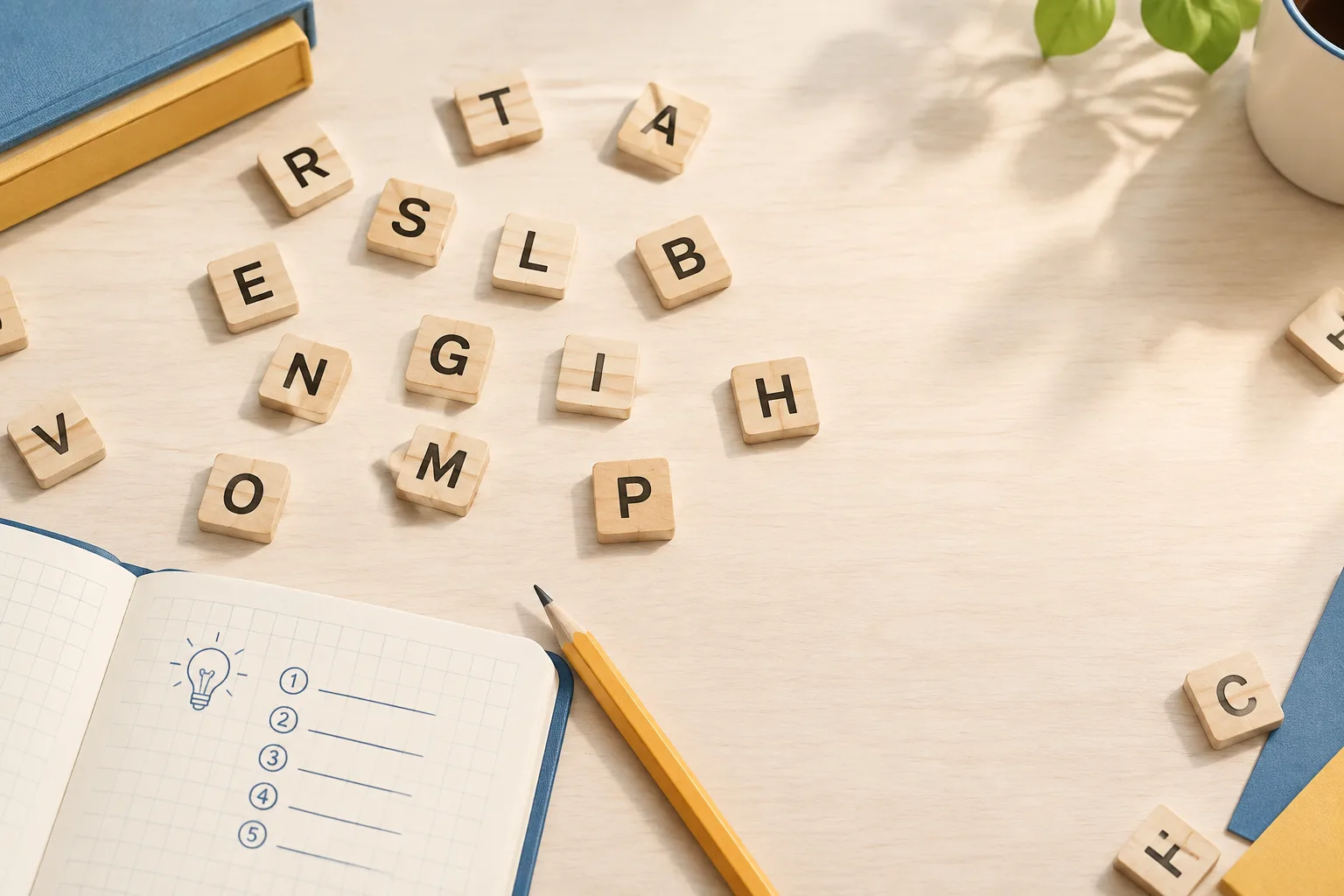
Jumbled letters look like noise until you give your brain a system to work with. Learning how to unscramble words is less about carrying an enormous vocabulary than about searching efficiently: find the anchors, test the likeliest patterns, then confirm your guess against a real word list. That approach works whether you are helping a student with spelling practice, hunting for a better word while writing, or staring at a rack of tiles in a word game. This guide lays out a five-step method, two worked examples, the word unscrambler tips that keep a tool genuinely useful, and drills that make you faster over time.
What Unscrambling Actually Asks You to Do
An anagram puzzle is a search problem wearing a vocabulary costume. A set of letters can be arranged in a fixed number of ways, and every one of those arrangements is a candidate; the dictionary decides which candidates count as words. Human brains are poor at enumerating permutations and excellent at recognizing patterns, so the goal is not to try every order. It is to shrink the candidate list until one answer stands out.
Two failures show up again and again. The first is reading left to right and hoping a word appears — that only works for short, obvious sets. The second is fixating on a possible first letter and refusing to abandon it even when the remaining letters do not cooperate. Careful solvers do the opposite: they start from the most constrained part of the word, usually the ending, and work backwards toward the beginning.
The Five-Step Method for Any Letter Set
Step 1: Sort and Count the Letters
Write the letters in alphabetical order and note any repeats. The set N, A, T, E, L, S becomes A, E, L, N, S, T with each letter used once. Sorting does two useful things: it breaks the order you were handed (which is itself a misleading clue), and it makes doubled letters impossible to overlook. A set containing two P's, like A, E, L, P, P, cannot be solved by anyone who forgets the duplicate is there.
Step 2: Find the Anchors
Anchors are the letters or letter pairs that limit the possibilities most sharply. Vowels come first — every English word needs at least one, and long vowel runs are rare. Next come consonant teams that behave as a single sound: th, sh, ch, ph, wh, ck, ng. If your set contains an H and a T, test TH combinations early, because those two letters are far more productive together than scattered apart.
Step 3: Guess the Ending Before the Beginning
English is rich in predictable endings, and each one consumes letters you no longer have to place. Common endings include -ing, -ed, -er, -est, -ly, -tion, -ness, -able, -ous, and -al. If your letters include I, N, and G, there is a reasonable chance they belong together at the end rather than spread through the middle. Stripping a suffix from the set usually leaves a short, recognizable stem.
Step 4: Build Around a Cluster
Once you have locked an ending or a consonant team in place, treat it as a fixed block and arrange the remaining letters around it. This is the moment when unscrambling letters to words stops feeling random. With a block like -ING pinned down, the question shrinks from "what does this whole pile spell?" to "which two or three letters can sit in front of it?" — a much smaller search space.
Step 5: Verify Against a Word List
A candidate is only an answer if a dictionary accepts it. Say the word aloud, check the spelling, and if you are playing a game, confirm it against that game's word list. When you are truly stuck, hand the letters to a digital solver — but read the results instead of copying the longest one. The list of accepted words is itself a clue about the patterns you are still missing.
Two Worked Examples
Six Letters, Four Answers: A, B, E, L, S, T
Sorted set: A, B, E, L, S, T. The consonants B, L, S, and T cluster naturally, and the vowels A and E want to sit between them. Testing the -LE ending gives TABLE with two letters left over; shifting the tail produces STABLE. Reading the same letters in a different rhythm yields BLEATS, and tightening the vowel placement gives ABLEST. Four valid words from one letter set — which is exactly why sorting and pattern testing beats guessing.
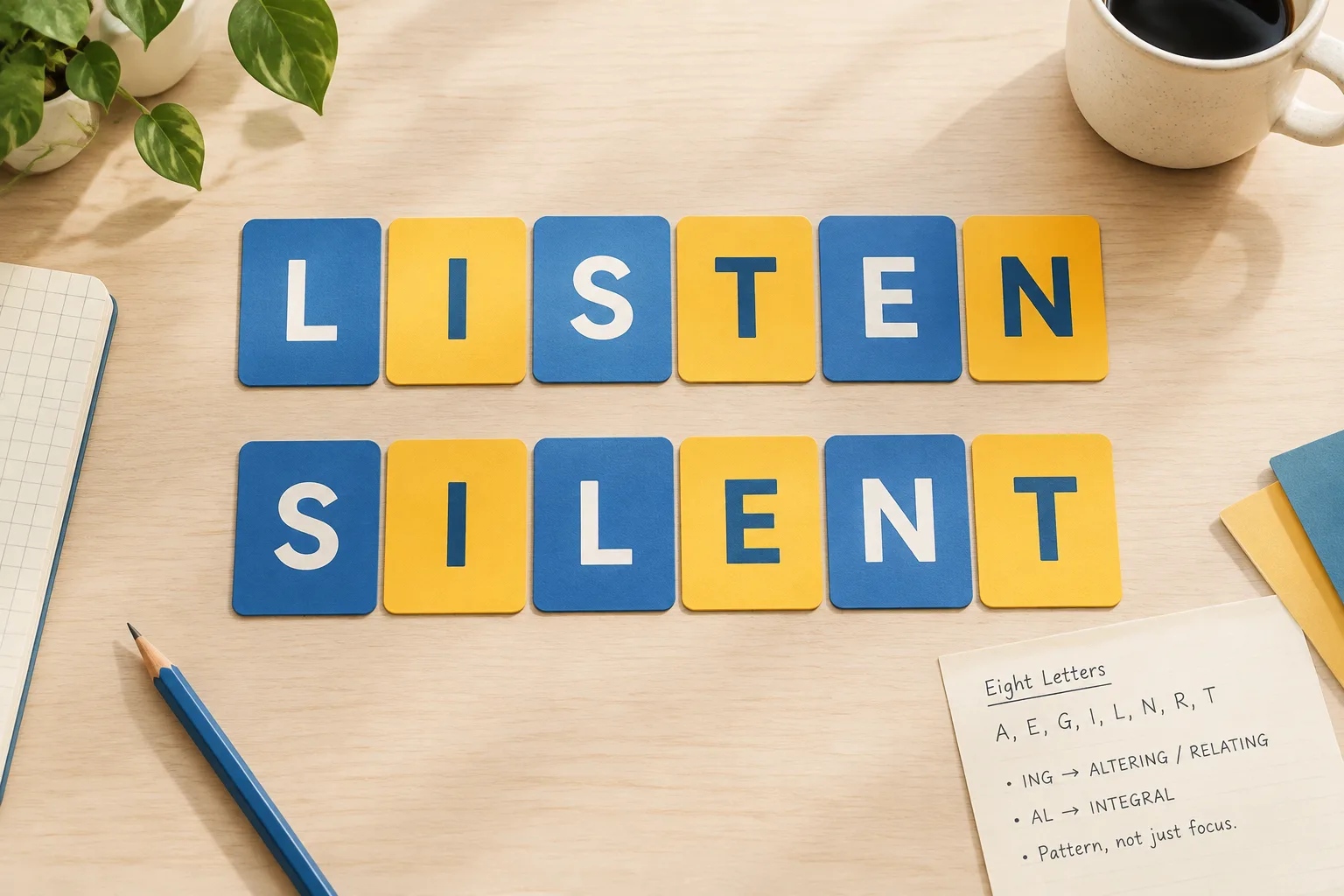
Eight Letters, Three Long Answers: A, E, G, I, L, N, R, T
This set contains the -ING cluster, a tempting place to start. Lock -ING at the end and arrange the remaining five letters (A, L, T, E, R): you land on ALTERING and, with the vowels reordered, RELATING. Abandon the -ING block and try an -AL ending instead, and INTEGRAL appears. Notice that each answer came from committing to a pattern, not from staring harder at the letters.
Word Unscrambler Tips: Getting More From a Solver
A good solver is a study partner, not an answer key. Used well, it shows you which patterns you keep missing; used carelessly, it replaces the thinking you were trying to practice.
Filter Before You Scroll
Most unscrambling tools let you constrain results: exact word length, starts with, ends with, contains these letters, excludes these letters. If you already know the word ends in -ED, set that filter first. Sorting results by length is also useful — short words are often the ones players overlook when they chase a long, flashy answer.
Know Which Dictionary You Are Playing Under
"Valid word" is not a universal fact; it depends on the list. Tournament Scrabble in the United States and Canada uses one official list, while much of the rest of the world uses a different, larger one. Mobile word games maintain their own curated dictionaries, and they disagree with each other about slang, abbreviations, and obscure entries. Two solvers can therefore return different answers for identical letters without either being broken.
Use Wildcards Deliberately
If your letters include a blank tile or a known-but-unplaced letter, enter it as a wildcard rather than running through the alphabet one letter at a time. A wildcard turns one search into a single query and keeps your shortlist readable.
Practice Drills That Build Real Speed
Speed in unscrambling comes from pattern recognition, and pattern recognition comes from volume — but the volume has to be varied. Try a random word generator to pull words you would never choose yourself, then jumble and solve them. Because the source words are unpredictable, you cannot rely on memory of yesterday's puzzle.
- Vowel-first drills: take any five-letter set and list every plausible vowel arrangement before touching the consonants.
- Ending hunts: give yourself a set and two minutes to find only words ending in -ER, then only words ending in -LY.
- Word-family ladders: build in a fixed family such as -IGHT (light, night, right, sight, tight, fight, might).
- Timed rounds: three minutes on a seven-letter set, then compare against a solver to see what you missed.
For writers, a related exercise is generating raw material rather than solving puzzles: pull a handful of words from a random word generator and a set of concrete random nouns, jumble them together, and write a paragraph that uses all of them. It trains the same muscle — spotting structure inside a pile of loose letters.
Common Mistakes That Keep Letters Jumbled
- Reading in the given order. The order you received is the least informative thing about the set.
- Fixing the first letter too early. If the rest of the letters refuse to cooperate, the first letter is probably wrong, not the whole idea.
- Forgetting repeated letters. A doubled consonant changes which endings are possible.
- Only looking for long words. Short words often unlock longer ones by revealing a usable stem.
- Treating one solver's output as law. Dictionary differences are real; check the list that governs your game or assignment.
- Skipping verification. A word you cannot spell is a word you cannot confidently use.
Unscrambling in the Classroom and at the Writing Desk
Unscrambling is quietly one of the most efficient vocabulary exercises available, because it forces attention to spelling, morphology, and word families at the same time. Teachers can hand out a letter set and ask students to find words of at least four letters, then sort their answers by ending — a five-minute activity that surfaces prefixes, suffixes, and silent letters.
At a writing desk, the same skill helps in a different way. When a precise word is on the tip of your tongue, working through its likely letters and endings often retrieves it faster than flipping through a thesaurus. If you would rather generate from a blank page than solve a puzzle, a word maker can turn a set of letters into candidate words you can then test in a sentence.
One honest caveat: in competitive play, checking a solver mid-game may violate the rules or an honor code. Use these tools to practice and to learn patterns, then solve unassisted when it counts.
FAQ
Is there a trick to unscrambling words quickly?
Yes, and it is the same trick every time: attack the ending before the beginning. Endings like -ING, -ED, -ER, -TION, and -NESS consume several letters at once and leave a short, recognizable stem. Combined with an alphabetized letter list, this cuts the candidates dramatically before you start guessing.
What should I do when the letter set contains duplicates?
Write the letters alphabetically and mark the repeats explicitly — for example, A, E, L, P, P rather than L, A, P, P, E. Duplicates rule out endings that would need a third copy of that letter and make double-consonant patterns like -PP- or -LL- more likely.
Why does one unscrambler give me different words than another?
Because they search different dictionaries. Tournament word lists differ by region, and app-based word games use their own curated lists. A tool is only "wrong" relative to the list you are actually being judged against, so check the rules of your game before trusting any single result.
Can unscrambling tools help with word games?
They can help you study, which is different from helping you win. Solvers are excellent for reviewing a rack after a game to see what you missed and for learning which letter combinations produce the most words. Using them during a live game may breach the rules, so treat them as practice equipment.
How do I unscramble a long set of letters, or a whole phrase?
Long sets are solved in chunks. Identify likely multi-letter blocks first (a suffix, a common digraph, a small preposition), treat each block as one unit, and then arrange the units. For phrases and names, it also helps to write out possible short words from the same letters and see which ones could plausibly join the others.
How can a student practice unscrambling without a teacher?
Use a two-minute timer and a random letter set, write down every word you can find, then check your list against a dictionary or solver and record the patterns you missed. Ten minutes a day is enough to notice improvement, and keeping a running list of missed patterns is more useful than replaying the same set.
Do I need a large vocabulary to unscramble words?
No, but you do need a working sense of English spelling patterns. Most puzzles are solved with common words; the rare entries that trip people up are usually learnable as pattern exceptions rather than as isolated vocabulary items.
Try It With Your Own Letters
Pick up whatever letters are nearest — a jumbled set from a puzzle, a word you half-remember from an email, a rack from last night's game — and run the five steps in order. Sort the letters, find the anchors, guess the ending, build around the block, then verify. If you want a faster starting point, the Word Maker will turn a set of letters into candidate words, and the random word generator will keep you supplied with fresh practice material so you never rehearse the same puzzle twice.