Random Noun Generator for Drawing: Sketch Prompts That Beat a Blank Page
A random noun generator for drawing turns a vague urge to sketch into a concrete prompt. Instead of waiting for inspiration, you get words like “lantern,” “otter,” or “staircase” and a simple rule: draw it. This guide explains how to use a random noun generator for drawing, how to turn a single noun into meaningful sketch prompts, and how to keep an art prompt generator from becoming a slot machine you spin without ever putting pencil to paper.
Why a Random Noun Generator Works for Drawing Practice
Blank-page paralysis usually comes from too many choices, not too few. A random noun generator for drawing reduces the decision to one word. That constraint is useful because drawing is a set of decisions: shape, proportion, value, edge, texture, composition. When the subject is chosen for you, you can spend your attention on those decisions.
Nouns are also naturally drawable. A noun names a person, place, thing, or idea, and for sketching you want the visible kind: teapot, bicycle, willow tree, fire hydrant, sleeping cat, subway platform. Concrete nouns give you edges and forms to observe. Abstract nouns can work too, but treat them as themes rather than subjects: “patience” might become a still life of a chess clock, a knitting project, or a dog waiting by a door.
A random noun generator is not a replacement for skill practice. It is a scheduling tool. It helps you start, and starting is the hardest part. If you already use a random noun generator guide for writing or word games, the same habit transfers neatly to drawing: generate, choose, commit, finish.
How to Use a Random Noun Generator for Drawing
The method matters more than the tool. Follow these steps to turn a random noun into a complete practice session.
1. Choose a drawing target before you generate
Decide what you are practicing today. Pick one: gesture, proportion, perspective, value, texture, color, or storytelling. If you choose “draw better” as your target, the prompt will not help. If you choose “show three values with one pencil,” the noun becomes a problem to solve.
2. Generate three to five nouns, then filter
Generate a small batch. Read them once, then pick the one that creates the most useful friction. If you want to practice cylinders, choose the thermos, not the butterfly. If you want to practice organic shapes, choose the cabbage, not the ruler. The generator gives options; your practice goal makes the choice.
3. Set a constraint and a timer
A constraint is what turns a sketch prompt into practice. Examples:
- 2 minutes: one continuous line, no lifting the pencil.
- 5 minutes: three values only, no outlines.
- 10 minutes: draw the noun from three angles.
- 20 minutes: place the noun in a room with a light source.
A timer prevents overworking. When the timer ends, stop. You can always generate another noun.
4. Sketch before you judge
Do not erase during the first pass. Do not fix proportions until you have the whole shape on the page. Many artists abandon a sketch because the first thirty seconds look wrong. A random noun generator for drawing is most useful when it forces you past that moment.
5. Review with one question
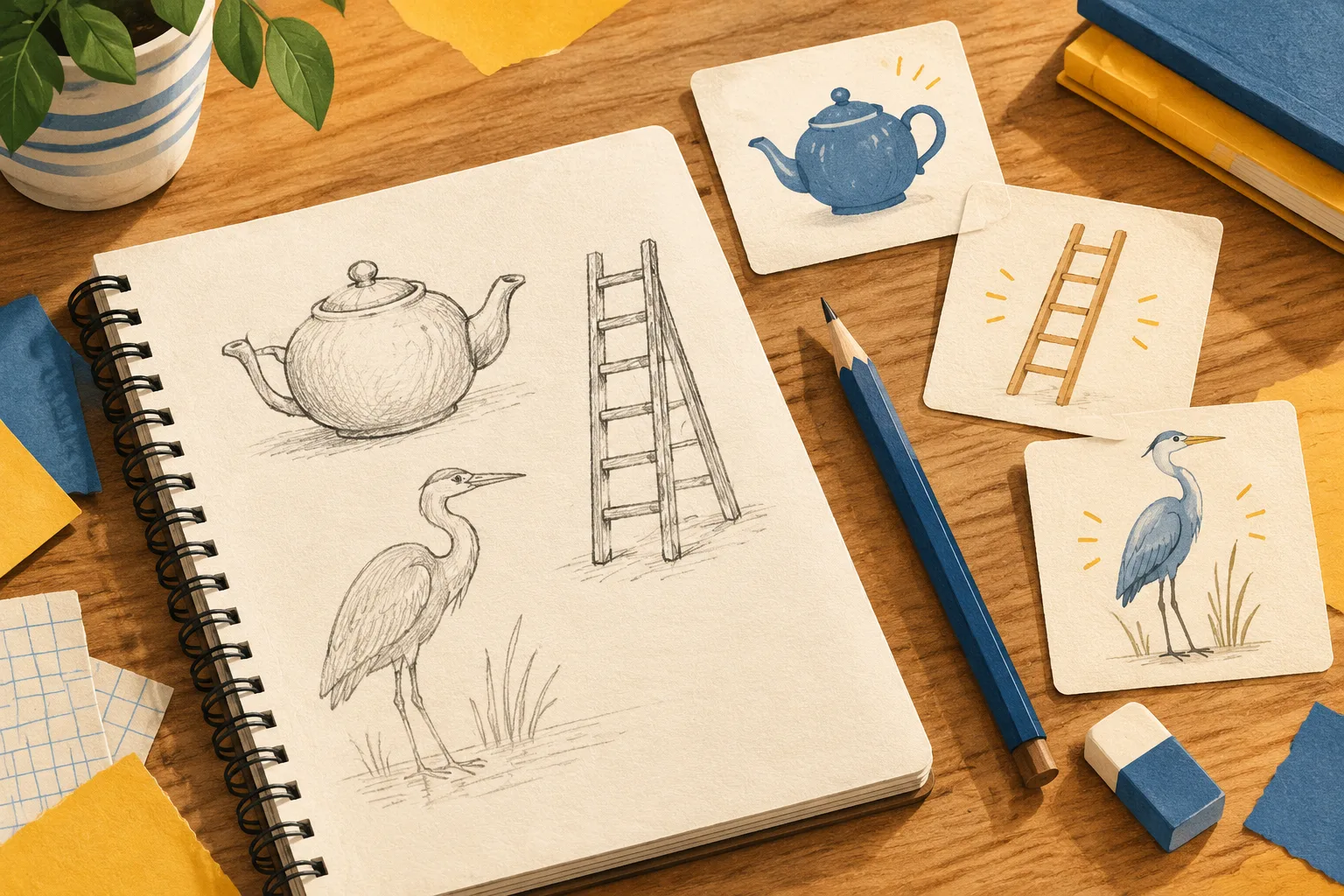
After the session, ask one question: “What did this noun make me notice?” Maybe the teapot made you notice ellipses. Maybe the heron made you notice negative space. Write the answer next to the sketch. That note becomes your next practice target.
Noun Categories That Make Strong Sketch Prompts
Not every noun works well for every session. Use these categories to steer the generator or to build your own fallback list.
Everyday objects
Teapot, umbrella, toaster, bicycle, ladder, watering can, lamp, boot, scissors, backpack, key, clock, chair, camera, lantern, basket.
Animals and creatures
Heron, fox, turtle, beetle, octopus, horse, snail, owl, crab, rabbit, moth, whale, lizard, squirrel, dragonfly, cat.
Nature and landscape
Willow tree, pinecone, cliff, river, mushroom, cactus, cloud, boulder, waterfall, fern, acorn, coral, iceberg, desert, volcano, nest.
Architecture and place
Staircase, bridge, lighthouse, window, doorway, fence, castle, market stall, subway platform, barn, tent, tower, alley, bench, pier, greenhouse.
Tools and machines
Wrench, telescope, sewing machine, typewriter, compass, pulley, camera tripod, microscope, anchor, wheelbarrow, clockwork, robot arm, bicycle pump, metronome, drill, engine.
Fantasy and story nouns
Potion, dragon egg, spell book, treasure chest, spaceship, crown, mask, portal, wand, map, keyhole, lantern festival, floating island, clock tower, secret door, friendly monster.
You can also combine categories. “Animal + architecture” gives a fox on a staircase. “Tool + nature” gives a wrench tangled in vines. These combinations are excellent sketch prompts because they force composition decisions.
8 Sketch Prompt Exercises Using a Random Noun Generator
These exercises work for solo practice, art class warm-ups, or a drawing group. Each one uses an art prompt generator as the starting point, then adds a clear rule.
1. The Two-Noun Mashup
Generate two nouns. Draw them interacting in one scene. Example: “lighthouse” and “octopus.” The octopus does not have to be realistic; it has to create a relationship. This exercise trains composition and storytelling.
2. The 60-Second Gesture
Generate one noun. Draw it in 60 seconds using only big shapes. Then draw it again in 30 seconds. Then 15 seconds. The goal is not accuracy but capturing the noun’s energy. Animals and people work well here.
3. The Memory Draw
Look at a reference of the noun for 30 seconds. Hide it. Draw from memory. When you finish, compare and note two differences. This builds visual memory and helps you draw from imagination later.
4. The Texture Study
Generate a noun with strong surface texture: pinecone, coral, woven basket, rusted anchor, bird’s nest, knitted scarf. Draw only the texture in a small square. Fill the square edge to edge. This is a low-pressure way to practice mark-making.
5. The Value Map
Choose a noun. Draw it with three values: light, middle, dark. No outlines. If you are using digital tools, use one brush and three gray swatches. If you are using pencil, use light pressure, medium pressure, and heavy pressure. The noun becomes a shape puzzle.
6. The Room Placement
Generate a noun and place it in a room. Add a floor line, a wall corner, and one light source. The noun does not need detail; the room needs believable space. This is a gentle introduction to perspective.
7. The Series of Ten
Generate one noun. Draw it ten times in ten minutes, changing one thing each time: angle, scale, material, era, weather, emotion. This exercise kills perfectionism because no single drawing matters too much.
8. The Classroom Relay
In a group, one student generates a noun. Everyone draws for three minutes. Then pass the paper to the left and add to the drawing for three more minutes. The final image is collaborative. For a word-game version, try how to play Pictionary and use the same noun list for drawing clues.
How to Use a Random Noun Generator in the Classroom
Teachers can use a random noun generator for drawing as a five-minute warm-up, a vocabulary bridge, or a listening activity. Write the generated noun on the board. Ask students to draw it without using words, then ask a partner to guess the noun. This connects drawing, observation, and language.
For younger students, choose concrete nouns: apple, shoe, fish, house, tree. For older students, add constraints: draw the noun from an ant’s point of view, draw it in only geometric shapes, draw it as a map. For language learners, pair the noun with a sentence frame: “This is a ___. It has ___. It can ___.” The drawing supports the sentence.
You can also link art warm-ups to word games. A round of how to play Pictionary uses the same skill: turning a word into a visual clue quickly. If your class writes as well as draws, a random word generator for writing can supply story nouns for both illustration and short scenes.
Common Mistakes When Using an Art Prompt Generator
Spinning instead of drawing
The biggest mistake is generating twenty nouns and drawing none. Set a rule: generate once, draw once. You can always generate again after the timer.
Choosing only easy nouns
Easy nouns feel good, but they do not stretch you. If you always draw cups and apples, add a rule: every third prompt must be an animal, a machine, or a place.
Skipping the warm-up
Jumping into a detailed drawing with cold hands and cold eyes is hard. Use a 60-second gesture or a texture square first. The random noun can be the warm-up or the main study.
Treating the sketch as a final piece
Sketch prompts are for practice. If every drawing must be portfolio-ready, you will slow down and avoid risk. Give yourself permission to make useful bad drawings.
Ignoring review
A sketch without a note is just a mark. Write one sentence about what worked or what confused you. Over a month, those notes become a personal curriculum.
From Sketch Prompt to Finished Piece
A random noun generator can also feed larger projects. Here is a simple progression:
- Generate a noun and do three thumbnails in five minutes.
- Choose the thumbnail with the strongest shape.
- Gather two or three references. Do not copy one image; study the object from different angles.
- Draw a larger value study. Keep it loose.
- Add color only after the values work.
- Finish with a clear focal point. Ask: where should the viewer look first?
This process works for illustration, comics, children’s books, and concept art. The noun gives you a subject; the process gives you a piece. If you get stuck, generate a second noun and combine it. “Bicycle” plus “storm” is a scene. “Teapot” plus “spaceship” is a story.
FAQ
What is a random noun generator for drawing?
A random noun generator for drawing is a tool that outputs a noun—such as “ladder,” “heron,” or “lighthouse”—to use as a sketch prompt. It removes the initial decision of what to draw so you can practice shape, value, composition, or storytelling.
Is a random noun generator better than an art prompt generator?
They serve different needs. An art prompt generator may give full scenes or styles, while a random noun generator gives a single subject. Nouns are flexible: you can turn one noun into a gesture study, a value study, or a finished illustration. Many artists use both.
How many sketch prompts should I do per day?
Consistency matters more than volume. Three to five short prompts can be enough for a daily habit. If you have more time, do one longer study and two quick warm-ups. Stop while you still have energy so you want to return tomorrow.
Can I use random nouns for classroom art?
Yes. Write a generated noun on the board and give a time limit. Students can draw, guess, or write about the noun. It works as a warm-up, a vocabulary activity, or a transition between subjects. Keep the rules simple and visible.
What should I do if I don’t like the noun?
Draw it anyway for five minutes. Disliking a noun often means it is unfamiliar, and unfamiliar subjects teach the most. If you truly cannot start, generate one more noun—but then commit to the timer.
Can I combine two random nouns?
Yes. Combining nouns is one of the best ways to create original sketch prompts. Generate two words, then ask: how do they interact? A “robot” and “garden” could become a robot watering flowers. A “crown” and “puddle” could become a fallen crown in the rain.
How do I keep from drawing the same thing every time?
Add constraints. Change the time limit, the tool, the viewpoint, or the number of values. Draw the noun from above, from below, or from inside. Use a random noun generator for drawing as a starting point, then let the constraint push you into new territory.
Ready to Beat the Blank Page?
Open Random Word Kit’s random noun generator, generate a noun, and set a five-minute timer. Draw the first thing that comes to mind, stop when the timer ends, and write one note about what you noticed. That small loop—generate, draw, review—is enough to turn a random noun generator for drawing into a steady creative practice.