
Pictionary Phrases: Word List and Cluing Tips
Pictionary phrases are the prompts players draw and guess in the classic sketch-and-guess party game. A good phrase gives the artist something visual to work with and gives the team a fair chance to guess before the timer runs out. This wiki collects ready-to-use pictionary phrase ideas, funny pictionary phrases, category lists, and practical cluing tips for family game night, classrooms, ESL practice, and online play.
What Makes a Good Pictionary Phrase?
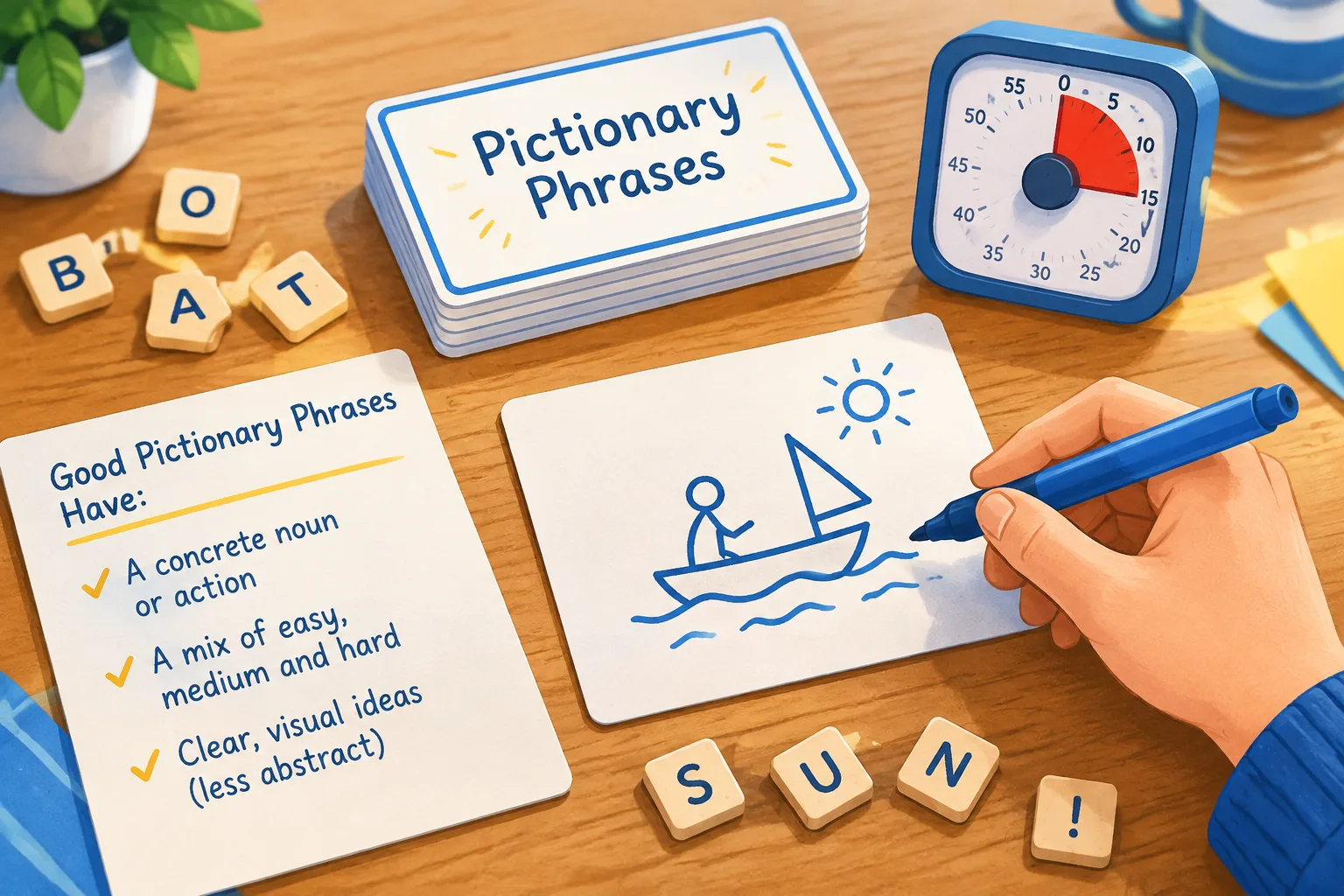
A strong pictionary phrase usually has at least one concrete noun or action. Abstract ideas can work as hard rounds, but they often lead to frustration if every card is abstract. The best lists mix easy, medium, and hard prompts.
Easy phrases: two or three words, familiar actions, clear shapes.
Medium phrases: a subject plus a setting or emotion.
Hard phrases: idioms, abstract concepts, or phrases with multiple meanings.
Avoid phrases that depend on tiny details, brand names, or text-heavy jokes. If the phrase cannot be drawn without writing letters, it is usually a poor fit.
Pictionary Phrase Lists by Category
Everyday Objects and Actions
Use these for warm-up rounds. They are easy to draw and easy to guess.
- brushing teeth
- making pancakes
- tying shoelaces
- wrapping a gift
- planting a seed
- washing dishes
- riding a bike
- packing a suitcase
- blowing bubbles
- taking a selfie
- feeding a pet
- opening a window
- folding laundry
- watering plants
- building a sandcastle
- waiting for a bus
- climbing a ladder
- baking cookies
- charging a phone
- sweeping the floor
Funny Pictionary Phrases
Funny pictionary phrases work when they describe an awkward, exaggerated, or unexpected situation. The humor should come from the scene, not from a private joke that only one player knows.
- sneezing in an elevator
- a cat knocking over a vase
- dancing with a broom
- a dog stealing a sandwich
- wearing mismatched socks
- trying to open a stubborn jar
- walking through cobwebs
- a pigeon on a pizza
- a robot vacuum chasing a cat
- slipping on a banana peel
- a toddler hiding a shoe
- a squirrel raiding a bird feeder
- a person stuck in a costume
- a Wi-Fi signal disappearing
- a balloon losing air
- a chicken crossing the road
- a snowman melting
- a phone buzzing in a movie theater
- a chef burning toast
- a mime trapped in a box
Idioms and Sayings
Idioms are classic pictionary phrases because they can be drawn literally or metaphorically. Decide before the game whether players may guess the literal image, the idiom, or both.
- raining cats and dogs
- break the ice
- piece of cake
- hit the books
- under the weather
- let the cat out of the bag
- break a leg
- cold feet
- on cloud nine
- time flies
- see eye to eye
- spill the beans
- the ball is in your court
- bite the bullet
- when pigs fly
- cost an arm and a leg
- burn the midnight oil
- pull someone's leg
- a fish out of water
- two peas in a pod
Hard Pictionary Phrases
Hard prompts can add drama to the last round. Use them sparingly and give more time.
- jealousy
- freedom
- gravity
- memory
- the internet
- sustainability
- algorithm
- nostalgia
- awkward silence
- deja vu
- teamwork
- peer pressure
- inflation
- artificial intelligence
- climate change
- social media
- procrastination
- empathy
- a fresh start
- a broken promise
Classroom and ESL Phrases
For classrooms, choose phrases that connect to vocabulary, routines, and school life. ESL teachers can pair drawings with sentence frames such as 'She is ___' or 'They are ___'.
- raise your hand
- line up at the door
- sharpening a pencil
- packing a backpack
- a science experiment
- show and tell
- recess
- homework
- a group project
- asking a question
- taking a test
- borrowing a book
- planting a class garden
- cleaning the whiteboard
- a field trip
- a fire drill
- lunch tray
- school bus
- library card
- online class
Holiday and Seasonal Phrases
Seasonal prompts are useful for parties, classroom celebrations, and family gatherings. Keep them broad enough for mixed ages.
- decorating a tree
- trick-or-treating
- lighting fireworks
- building a snowman
- hunting for eggs
- blowing out birthday candles
- Thanksgiving dinner
- New Year's countdown
- carving a pumpkin
- hanging stockings
- Valentine's card
- summer picnic
- beach umbrella
- first day of school
- autumn leaves
- spring cleaning
- winter scarf
- fireworks finale
- holiday baking
- family photo
How to Give Good Clues in Pictionary
Cluing is a skill. The clue giver needs to guide the team without saying the answer or any part of it. These habits help.
Start with categories
Say 'movie', 'animal', 'action', or 'place' before anything else. Categories narrow the search space quickly. For a phrase like 'raining cats and dogs', start with 'weather idiom' or 'saying'.
Use word count and blanks
Announce how many words are in the phrase. You can tap the table for each word and hold up fingers for syllables. Many players find blank beats helpful: 'blank blank on a blank'.
Go broad, then narrow
Begin with the general scene. If the phrase is 'making pancakes', you might say 'breakfast', 'cooking', 'something round', then 'flip'. Do not jump to obscure hints before the team has a category.
Use opposites, rhymes, and sounds
If the answer is 'cold feet', you can say 'opposite of hot' and point to your feet. For 'break the ice', you can mime cracking and then point to a frozen surface. Sound effects are allowed in casual games unless your house rules say otherwise.
Avoid forbidden words
Most Pictionary rules forbid saying the word, writing letters, and using gestures that form letters. Check your rulebook or agree on house rules before play. If you accidentally say part of the answer, the other team can call it out.
Watch the timer
Spend no more than 15 to 20 seconds on a single clue if the team is stuck. Switch to a different angle: category, function, size, or a related object. A calm pace is better than panic.
Pictionary Phrase Ideas for Different Settings
Family game night
Mix easy actions with funny scenes. Keep a few hard cards for the final round. Younger players often do well with animals, food, and holidays.
Classroom use
Connect phrases to the week's vocabulary. For example, if students are learning cooking verbs, use 'chopping onions', 'boiling pasta', and 'setting the table'. Add a rule that guessers must say a full sentence.
Party with adults
Use idioms, pop-culture-style scenarios, and awkward moments. Avoid inside jokes unless the whole group knows them. A good adult pictionary phrase is funny to watch, not just funny to the clue giver.
Remote or online play
Use a shared whiteboard or a drawing app. The clue giver can share a screen while teams guess in chat. Keep phrases shorter because lag and small screens make details harder to see.
Team-building
Choose workplace-safe phrases: 'deadline', 'brainstorm', 'coffee break', 'team huddle', 'sending an email', 'fixing a printer', 'presenting a slide', 'onboarding', 'working remotely', 'a lightbulb moment'. Avoid anything that could embarrass a colleague.
How to Build Your Own Pictionary Phrase List
- Pick a theme: food, travel, school, animals, holidays, or idioms.
- Write 20 easy, 20 medium, and 20 hard phrases.
- Check each phrase for drawability. If it needs text, replace it.
- Remove trademarks, brand names, and private references.
- Test the list with a small group and note which cards cause confusion.
- Shuffle the cards so easy and hard prompts mix naturally.
- Add a few blank cards so players can invent their own.
If you need fresh nouns, verbs, or adjectives, use a random word generator to spark combinations. A random noun generator is especially useful for object-based rounds. For writing prompts and classroom warm-ups, a random word generator for writing can help you build themed lists quickly.
Common Mistakes and Troubleshooting
Too abstract: If every card is 'justice' or 'happiness', teams will stall. Balance abstract cards with concrete ones.
Too similar: Avoid cards like 'cat' and 'kitten' in the same round. They create guess confusion.
Clue giver says the answer: Set a penalty, such as losing the turn or returning the card.
Teams argue: Appoint a neutral judge or use a simple house rule: if the majority hears the answer, it counts.
One player dominates: Require each team member to draw at least once.
Timer issues: Use a visible timer and agree on the length before the game starts. For casual play, 60 seconds per turn is common, but adjust for age and difficulty.
Quick Reference: 100 Pictionary Phrase Ideas
Here is a compact list you can copy into cards. Mix categories and difficulty levels.
- brushing teeth
- making pancakes
- tying shoelaces
- wrapping a gift
- planting a seed
- washing dishes
- riding a bike
- packing a suitcase
- blowing bubbles
- taking a selfie
- feeding a pet
- opening a window
- folding laundry
- watering plants
- building a sandcastle
- waiting for a bus
- climbing a ladder
- baking cookies
- charging a phone
- sweeping the floor
- sneezing in an elevator
- a cat knocking over a vase
- dancing with a broom
- a dog stealing a sandwich
- wearing mismatched socks
- trying to open a stubborn jar
- walking through cobwebs
- a pigeon on a pizza
- a robot vacuum chasing a cat
- slipping on a banana peel
- raining cats and dogs
- break the ice
- piece of cake
- hit the books
- under the weather
- let the cat out of the bag
- break a leg
- cold feet
- on cloud nine
- time flies
- jealousy
- freedom
- gravity
- memory
- the internet
- sustainability
- algorithm
- nostalgia
- awkward silence
- deja vu
- raise your hand
- line up at the door
- sharpening a pencil
- packing a backpack
- a science experiment
- show and tell
- recess
- homework
- a group project
- asking a question
- decorating a tree
- trick-or-treating
- lighting fireworks
- building a snowman
- hunting for eggs
- blowing out birthday candles
- Thanksgiving dinner
- New Year's countdown
- carving a pumpkin
- hanging stockings
- a detective in the rain
- a pirate looking for treasure
- a wizard's first spell
- an astronaut floating
- a knight and a dragon
- a chef tasting soup
- a photographer chasing a sunset
- a hiker reading a map
- a pilot landing a plane
- a scientist mixing potions
- a busy airport
- a quiet library
- a crowded beach
- a snowy mountain
- a dark cave
- a sunny kitchen
- a messy desk
- a secret garden
- a space station
- a treehouse
- solving a puzzle
- telling a secret
- waiting in line
- missing a train
- learning to swim
- flying a kite
- losing your keys
- finding a wallet
- singing in the shower
- laughing too hard
FAQ
What are pictionary phrases?
Pictionary phrases are prompts that one player draws while teammates guess. They can be objects, actions, idioms, titles, or situations. The best pictionary phrases are visual enough to sketch and specific enough to guess under time pressure.
What are some funny pictionary phrases?
Funny pictionary phrases often describe awkward or exaggerated scenes, such as 'sneezing in an elevator', 'a cat knocking over a vase', or 'a robot vacuum chasing a cat'. The humor should be clear to everyone playing, not an inside joke.
How do you make a pictionary phrase easier?
Use a concrete noun plus a familiar action, such as 'washing dishes' or 'riding a bike'. You can also allow more time, give a category, or accept close guesses. Easy phrases usually have clear shapes and common vocabulary.
How do you make a pictionary phrase harder?
Choose abstract nouns like 'nostalgia' or 'gravity', idioms with double meanings, or phrases with similar-sounding alternatives. You can also reduce the time limit, ban verbal clues, or require exact wording.
Can I use pictionary phrases for ESL classes?
Yes. Use school and daily-life phrases such as 'raise your hand', 'packing a backpack', or 'waiting for a bus'. Ask students to guess with full sentences and write the phrase on the board after the round to reinforce vocabulary.
How many words should a pictionary phrase have?
Two to four words is a practical range for most games. One-word prompts can work for objects and actions, while longer phrases are better for advanced rounds, idioms, or team challenges.
What should you not do when giving clues?
Do not say the answer or any part of it, do not write letters, and avoid spelling or mouthing the word. Check your rulebook or house rules for what counts as a gesture. If you break the rule, the other team may get the turn.
How can I generate random pictionary phrases?
Combine a random noun with a random verb or setting. For example, pair an object like 'umbrella' with an action like 'chasing' and a place like 'beach'. A random word generator can help you create fresh combinations quickly.
Ready to Build Your Next Word List?
Use Random Word Kit's random word generator to create themed pictionary phrases, classroom prompts, and writing warm-ups. Start with a category, generate a set of words, then combine them into drawable scenes. For more word-game and classroom ideas, explore the wiki.